Check Engine Light: 6 Essential Moves Before Tuning
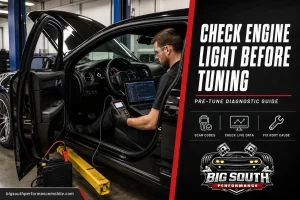
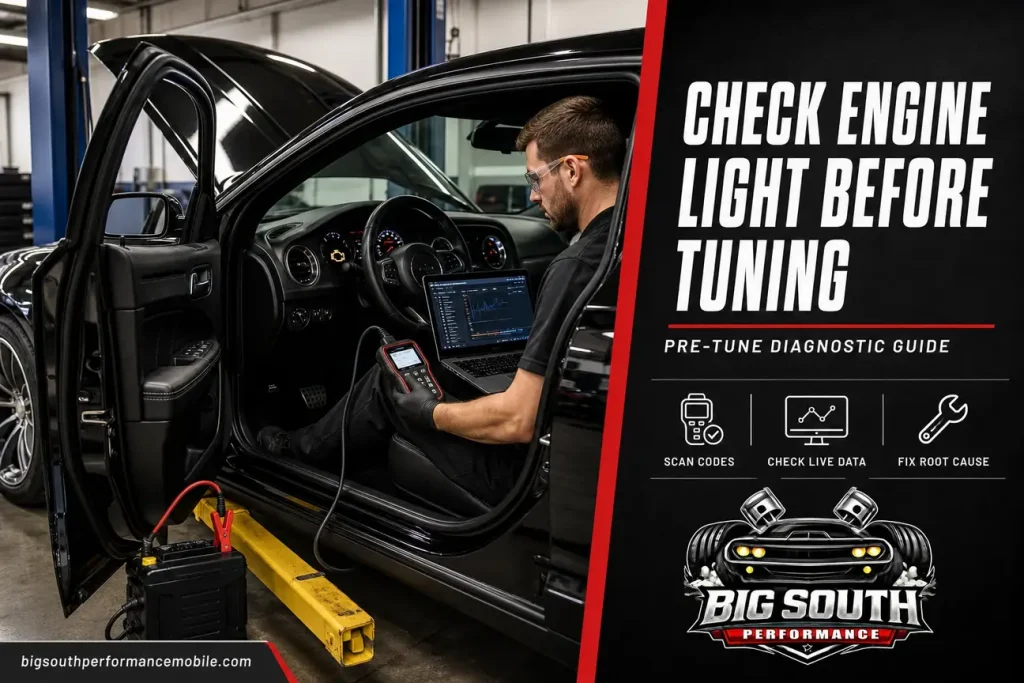
Quick Answer: If the check engine light is on, the smart order is simple: scan first, diagnose the cause, repair the fault, then tune or modify. A tune cannot fix a mechanical, fuel, ignition or wiring fault, and building a calibration around a sick vehicle can make drivability problems harder to sort out. The same goes for installing bolt-ons, forced induction parts, swap components or other upgrades before you know why the light came on.
NC inspection update as of October 2, 2026: The 19-county emissions requirement still applies, including Forsyth County, and qualifying vehicles still need the required OBD emissions inspection where applicable. North Carolina has enacted legislation intended to end the statewide emissions inspection program once final federal approval and implementation are complete; annual safety inspections remain. Check current NCDMV and NC DEQ requirements before making inspection or modification decisions.
For performance-minded owners in Winston-Salem, this is not about slowing the build down for no reason. It is about getting the sequence right. A mechanically sound vehicle gives the calibration a better starting point, helps separate real tuning needs from repair issues, and avoids using software to cover up a problem that should be diagnosed. Big South Performance approaches tuning, programming and upgrades as a complete system around the vehicle’s condition, intended use and supporting modifications.
1. Scan the check engine light before calibration
A warning light is not a parts list. It is a request for diagnosis. Modern OBD systems monitor engine operation, emissions-related systems, sensors and control modules, then store information as diagnostic trouble codes when the vehicle sees something outside its expected range. The NC DEQ Inspection/Maintenance Program explains that OBD systems help determine whether emissions-control devices are deteriorating or failing and use diagnostic trouble codes to communicate detected problems.
That matters before ECU tuning because calibration work depends on trustworthy information. If an oxygen sensor circuit, airflow reading, fuel-trim issue, knock signal, charging fault or intermittent wiring problem is already present, the ECU may be reacting to bad data. Changing the tune before fixing the cause can mask the problem, move the symptom or create a confusing baseline.
Think of it like setting up suspension on worn-out tires. You can adjust things, but the feedback is not clean. The same is true with calibration. If the vehicle is misfiring, going lean or rich, overheating, dropping voltage or setting communication faults, the tune is not the first repair. The first job is to find out what the car is actually doing.
Owners often ask whether a tune can “turn off” a nuisance light. That is not the right goal for a street vehicle. Big South Performance does not provide emissions-control removal or tunes that disable emissions monitors. The right path is to diagnose and repair the condition that caused the light, then decide whether tuning, flash programming or hardware upgrades make sense for the vehicle and its intended use.
2. Treat misfire codes as a pause button
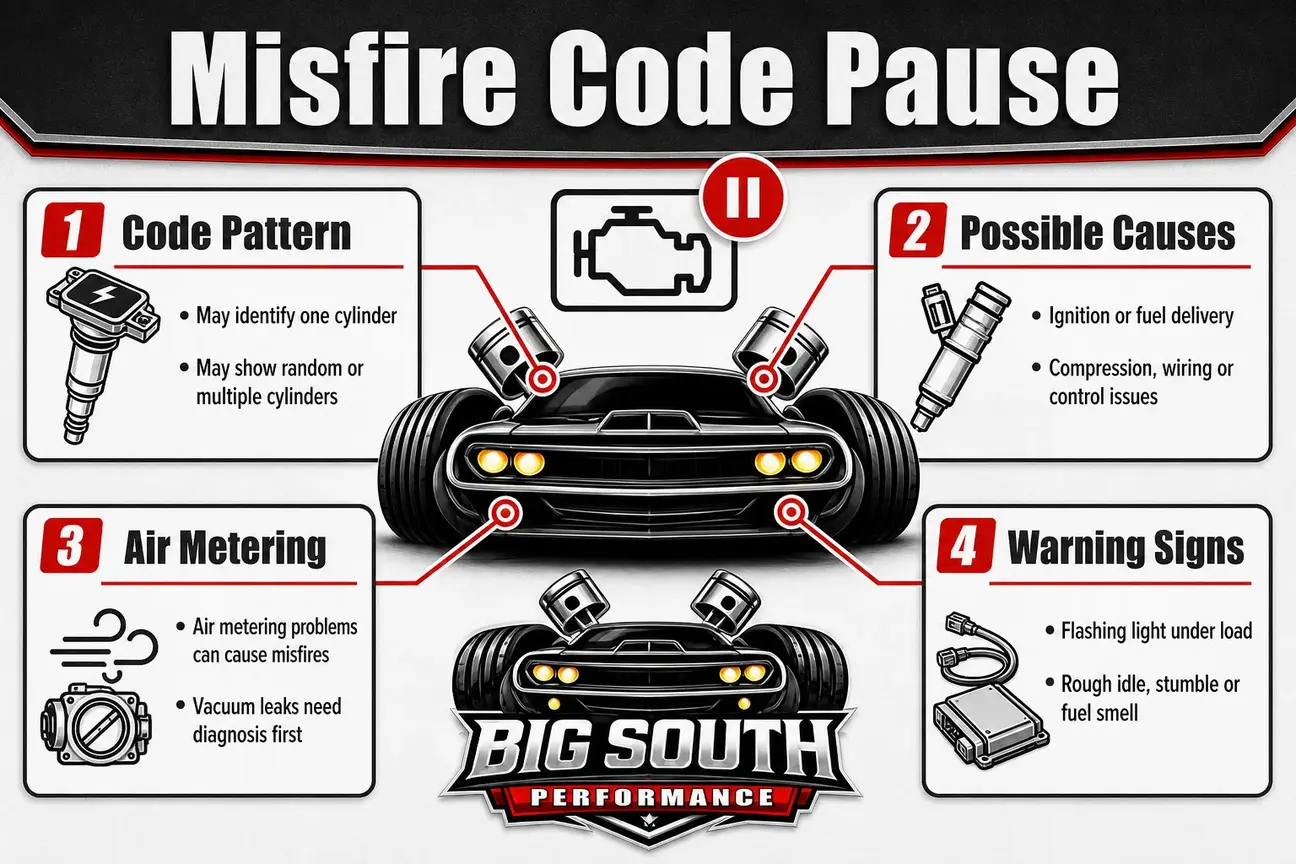
Misfire codes are a hard stop before performance work. A misfire may be caused by ignition, fuel delivery, compression, air metering, vacuum leaks, wiring or control issues. The code may identify a cylinder, or it may show a random or multiple-cylinder pattern. Either way, the tune is not a magic eraser. The car needs a diagnostic process before more load, more airflow or more fuel demand gets added.
Common symptoms that should be checked before tuning or installing parts include:
- Flashing warning light, especially under load
- Rough idle, shaking or uneven exhaust note
- Hesitation, stumble or breakup during acceleration
- Fuel smell, poor hot starts or black smoke
- Surging cruise, stalling or inconsistent throttle response
- Overheating, coolant loss or unexplained temperature swings
- Battery, charging or communication warnings
- Recently cleared fault codes that return after a drive cycle
A flashing warning light should be treated more seriously than a steady light because it can point to an active misfire condition. Do not keep loading the engine to “see if it clears up.” If the vehicle is shaking badly, losing power, overheating, showing low oil pressure or acting unsafe, stop driving and arrange a proper diagnosis. Simple owner checks are fine: verify fluid levels when the vehicle is cool, note warning lights, listen for obvious changes, and avoid opening a hot cooling system.
Misfire codes can also protect the build budget. If a coil, injector, plug, wiring issue or mechanical problem is already causing the car to run poorly, performance parts may not fix the complaint. Worse, they can add new variables. A staged build works best when the first stage is confirming that the base vehicle is healthy enough to support the next change.
Postpone tuning or hardware installation when the vehicle has active misfire codes, fuel pressure concerns, overheating, unstable charging voltage, communication faults, unknown wiring issues, or sensor data that does not match the vehicle’s behavior. Those problems are not “tuning quirks.” They are baseline issues that can affect drivability and calibration work.
3. Use a diagnostic scan to prove causes, not guess parts
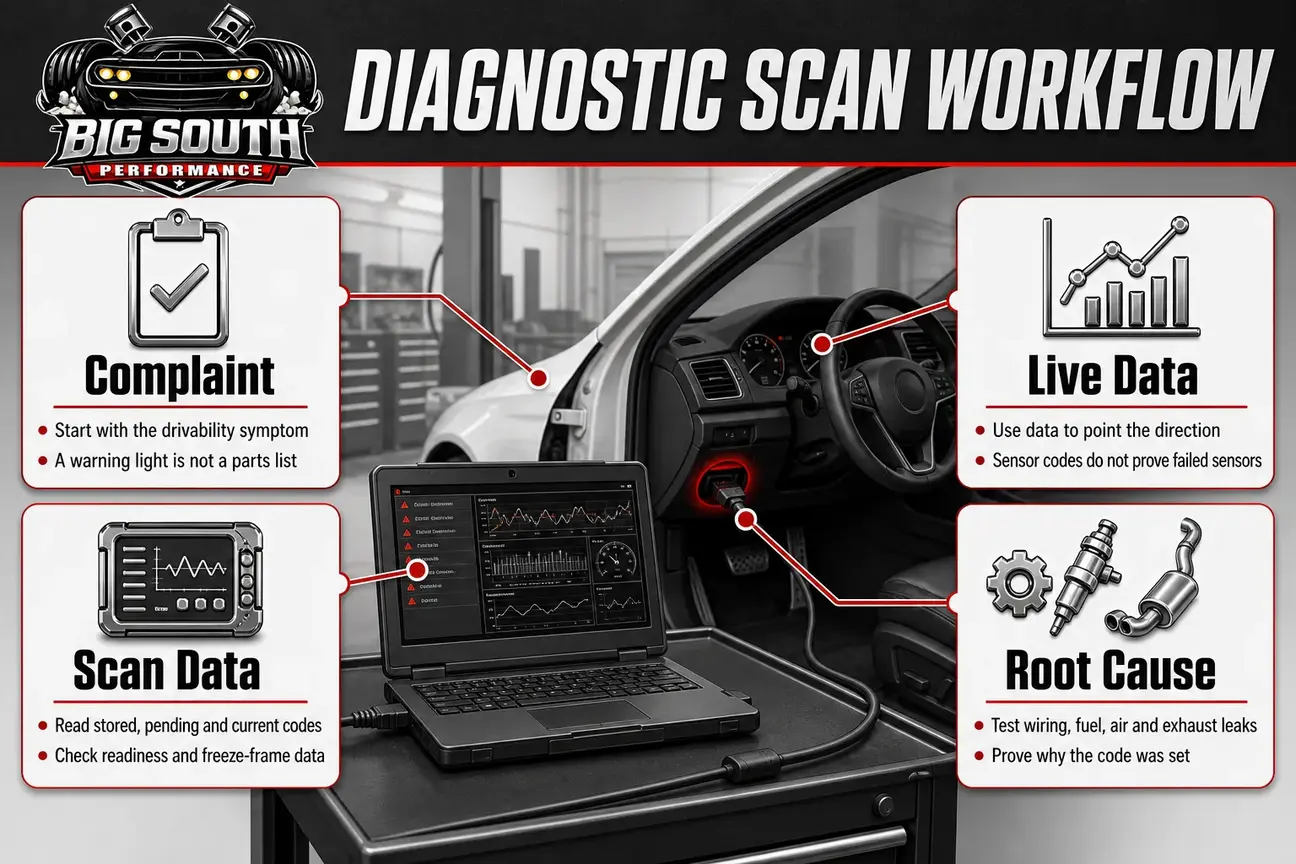
A diagnostic scan is the starting point, not the whole diagnosis. A scan tool can show stored, pending and current fault codes, readiness monitor status, freeze-frame information and live data. That information helps point the direction, but it does not automatically prove which part is bad. A code for a sensor reading does not always mean the sensor itself failed.
For example, an oxygen sensor-related code may be caused by an exhaust leak, wiring concern, fuel control issue or another condition that changes the sensor’s reading. A lean code may involve unmetered air, low fuel delivery, incorrect airflow data or other causes. Fault codes are clues. The diagnostic work is proving why the clue appeared.
A practical pre-tune diagnostic scan looks at more than the headline code. It should consider:
- Whether the code is current, pending, history or intermittent
- Freeze-frame conditions such as engine load, coolant temperature and vehicle speed
- Fuel trims and sensor readings at idle, cruise and load where appropriate
- Readiness monitor status after codes were cleared
- Battery voltage and module communication health
- Whether previous modifications changed intake, exhaust, fuel, ignition or control systems
- Whether the vehicle has unknown software, a replacement module or unfinished swap wiring
For a modern street car, this helps decide whether the next move is repair, flash programming, calibration, or no software change at all. For a swapped or restomod vehicle, the diagnostic scan may also reveal module communication problems, mismatched components or sensor inputs that do not agree with the current setup.
Big South Performance’s performance build planning mindset fits here: diagnose first, then plan the upgrade path. That does not mean every car has to be perfect before any part is discussed. It does mean the vehicle needs a clean enough baseline that the shop can tell the difference between a calibration need and a repair problem.
Fault codes can be useful, but treating them as a shopping list is how owners end up replacing parts without fixing the vehicle. A code identifies a circuit, system or condition the ECU has flagged. It does not always identify the failed component. That distinction matters when the next step might be performance parts installation or a calibration change.
A code for an airflow or fuel-trim issue might appear after an intake change, but the cause could be a leak, incorrect installation, wiring damage, a calibration mismatch or an unrelated fault that appeared at the same time. A throttle or pedal code may require electrical testing, not a new throttle body by default. Fault codes narrow the field; testing confirms the repair.
4. Repair fault codes and readiness issues before clearing anything
Clearing codes erases stored information; it does not repair the cause. It can also reset readiness monitors, which matters for owners in emissions-inspection counties. The NCDOT emissions inspections page explains that a vehicle can fail if it fails the emissions inspection analysis of data provided by the on-board diagnostic equipment.
For Winston-Salem owners, that local context matters because Forsyth County is part of the emissions-inspection program while it remains in effect. A car that recently had codes cleared may not be ready for inspection until monitors run, and if the underlying fault returns, the vehicle can still fail. Clearing a code to get past a light is not the same as fixing the vehicle.
It also hurts the diagnostic process. Freeze-frame data and code history can help a shop understand when the problem happened. Was it cold start, hot idle, cruise, heavy load or after refueling? If the codes are cleared without capturing that information, the next diagnostic step may take longer because the evidence is gone.
There is a performance reason too. If you clear the light, install parts and then ask for a tune, the shop may be looking at a vehicle with incomplete readiness data and no history. That makes it harder to know whether a new symptom came from the part, the old fault, the tune, or the installation. The cleaner path is to scan, document, diagnose and repair first.
Unresolved faults can affect three different areas: how the vehicle drives, whether required monitors complete, and whether calibration changes can be evaluated cleanly. Those areas overlap, but they are not the same. A car may feel decent yet still have pending codes. Another may have no obvious warning light but show data that points to a developing issue.
| Problem area | Why it matters before tuning | Better next step |
|---|---|---|
| Misfire, rough idle or breakup | Can make fuel, spark and airflow changes unreliable to evaluate | Diagnose ignition, fuel, wiring and mechanical condition before calibration |
| Sensor or circuit fault codes | Can feed bad data to the ECU or show a control issue that software should not hide | Test the circuit and cause, then confirm data is stable |
| Readiness monitors incomplete | Can affect inspection status in applicable NC counties | Repair the cause and confirm monitors complete under normal operation |
| Unknown previous tune | Can make current data harder to interpret and may not match the installed parts | Evaluate the vehicle, software state and hardware combination before changes |
| Cooling, charging or fuel delivery concerns | Can become more obvious when power demand, heat or electrical load increases | Correct supporting-system issues before adding performance load |
A tune changes how the ECU commands or interprets certain operating conditions. It cannot restore compression, repair a failing fuel pump, fix damaged wiring, stop an intake leak, correct overheating or make a weak charging system stable. When a vehicle already has fault codes, the calibration work should not become a substitute for diagnosis.
NC inspections add another practical reason to fix the source. North Carolina also requires annual safety inspections, and the NCDOT safety inspections page is the place to confirm current safety inspection requirements. Emissions rules and safety rules are separate, so an owner should not assume an emissions change eliminates safety obligations.
EPA rules also matter when the conversation turns toward emissions-related parts or software. The EPA tampering policy says the Clean Air Act prohibits tampering with emissions controls and prohibits making or selling products whose principal effect is bypassing, defeating or rendering emissions controls inoperative. Big South Performance does not recommend using a tune to hide a fault or disable required systems on a street vehicle.
5. Match the fix-first plan to street, weekend or motorsport use
Some upgrade requests can be planned while diagnosis is underway. Others should wait until the fault is repaired and verified. The deciding factor is whether the current problem affects the same systems the upgrade will depend on. If it does, pushing ahead usually creates more variables instead of a better car.
For bolt-on upgrades, the same rule applies. If the intake, exhaust, fuel system, ignition or cooling system already has a problem, installing parts may make the symptom more obvious. If the car has a drivability complaint after a previous modification, the first question is not “what should we add?” It is “what changed, what codes are stored, and what does the data show?”
For flash programming and updates, voltage stability and module communication are especially important. Programming is not the time to gamble with a weak battery, poor connections or modules that are already dropping offline. Owners should avoid disconnecting batteries, probing circuits or attempting module work without the right process and equipment.
For swaps and restomods, diagnosis can be more involved because the vehicle may combine older chassis wiring with newer powertrain controls. If you are planning engine swap planning, the pre-build discussion should include emissions requirements, module compatibility, fuel delivery, cooling, exhaust routing, gauges, wiring and intended use. The same fix-first mindset applies before the calibration stage.
The diagnose-first rule does not change, but the plan after diagnosis may differ by intended use. A street car usually needs smooth cold starts, stable idle, normal accessories, predictable part-throttle response and compliance with applicable road-use requirements. If it carries passengers, sits in traffic and sees summer heat, supporting systems matter as much as the exciting parts.
A weekend car may be less sensitive to some comfort concerns, but it still should not be tuned around unresolved misfire codes or unstable sensor data. If the car is already modified, the shop needs to understand the installed parts, wiring changes, fuel used and previous software history before making a recommendation.
A motorsport hobby build can involve different priorities, but it still needs a mechanically sound baseline. Sanctioned-event use can place more heat and load on the vehicle than a short street pull. Cooling, fuel delivery, tires, brakes, suspension and drivetrain condition all matter. If the vehicle has a warning light or recurring fault codes, those issues should be sorted before asking the combination to work harder.
That is why “plan before you buy parts” is more than a slogan. Buying a throttle body, intake, camshaft, injector set, forced-induction kit or swap harness before diagnosis may lock you into parts that do not solve the actual issue. A staged build starts with the car you have, not the online cart.
6. Send the right details before ECU tuning or flash programming
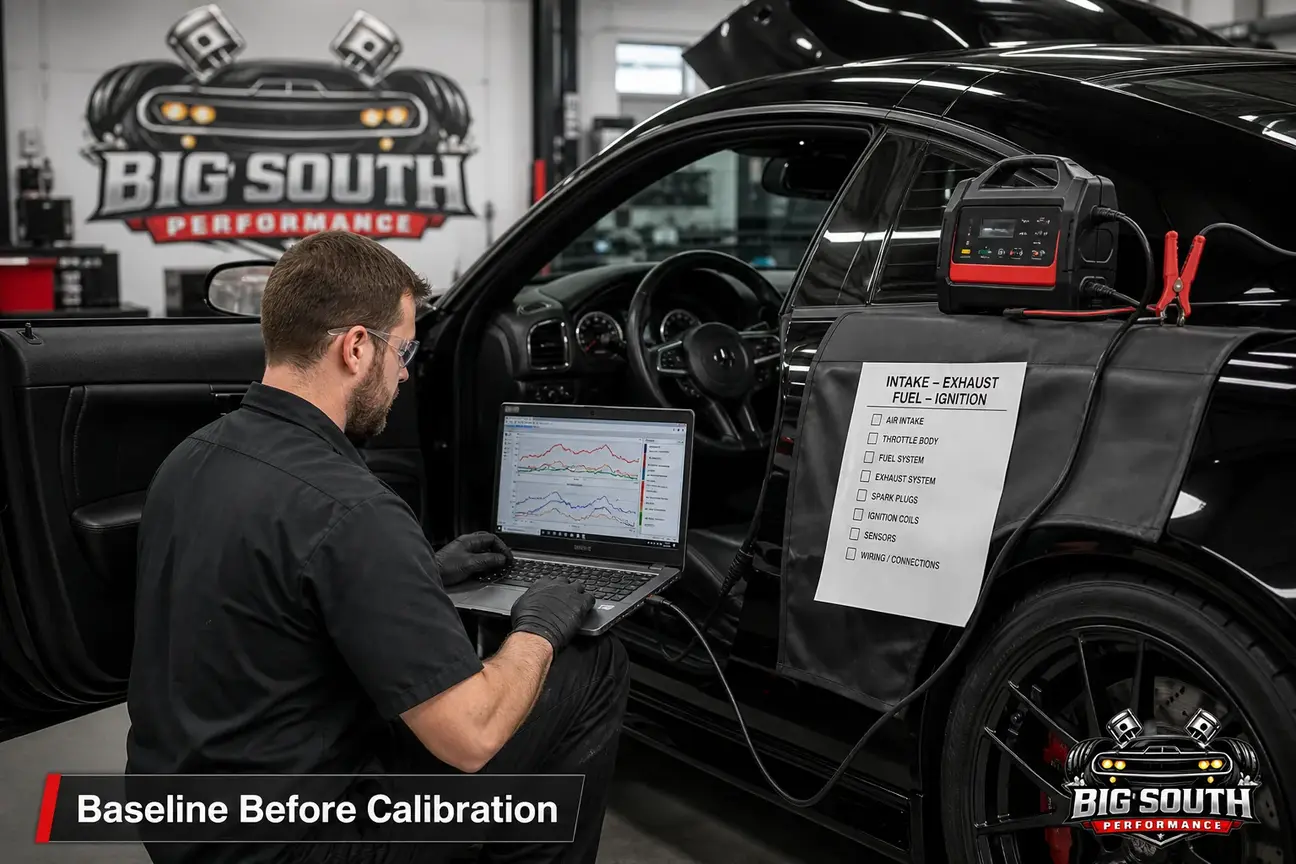
A strong pre-upgrade workflow is not complicated, but it does need discipline. The goal is to build a usable baseline before any tune, programming step or hardware change. That baseline helps the shop make a recommendation that fits the car instead of guessing from a warning light alone.
- Capture the complaint. Note when the light came on, how the vehicle drives, whether the symptom is constant or intermittent, and what changed recently.
- Run a diagnostic scan. Record stored, pending and current codes, freeze-frame data, readiness status and relevant live data.
- Separate symptoms from causes. Use testing to determine whether the issue is mechanical, electrical, fuel-related, ignition-related, software-related or installation-related.
- Repair the root issue. Do not use a tune or code clearing to hide the concern.
- Verify the repair. Confirm the symptom is gone, data looks reasonable and relevant monitors complete where applicable.
- Plan the upgrade. Match the calibration or hardware path to the vehicle’s condition, supporting systems and intended street, weekend or motorsport use.
This sequence supports a complete-system approach. A daily street car in Winston-Salem needs clean drivability in heat, traffic and normal inspection use. A weekend car may accept different trade-offs, but it still needs a healthy fuel, ignition, cooling and electrical foundation. A motorsport-focused vehicle should be planned around sanctioned use, maintenance expectations and supporting systems, not peak-number talk.
If you want Big South Performance to look at a warning light before tuning, send us your vehicle details: year, make, model, engine, VIN, current modifications, symptoms, stored or pending fault codes, scan screenshots if you have them, and your goals. You can also call (336) 512-2447 Mon-Fri 9AM-6PM EST. Submitting details helps the shop review the request; it does not confirm an appointment by itself.
You do not need to become a technician before asking for help. A few safe observations can make the first conversation more useful. Do not work under a vehicle without proper support, do not open a hot cooling system, do not disturb fuel lines, and do not attempt programming work with questionable battery voltage. Keep the owner-side checks simple.
Useful information includes:
- Whether the warning light is steady or flashing
- Whether the vehicle feels normal, rough, low on power, hot, or unstable
- Any recent repair, battery disconnect, part installation or fuel change
- Whether the issue started after a modification
- Photos of visible part numbers, aftermarket components or wiring concerns
- Scan-tool screenshots showing fault codes, readiness and freeze-frame data
- Current fuel type and whether the vehicle is driven daily, on weekends or for sanctioned motorsport use
A basic code reader can help you record fault codes, but a reader is not a final answer. If you run a diagnostic scan, save the codes before clearing anything. If the light is flashing, the vehicle is overheating, or the engine is running very poorly, avoid extra driving just to collect more data.
Owners with older classics planning modern swaps have a different kind of homework. Gather what you know about the engine, harness, ECU, transmission, fuel system, cooling system and previous work. For LS or other powertrain conversions, LS swaps and broader swap projects depend on compatible systems working together, not just the engine starting.
Performance parts and tuning can raise warranty and inspection questions, so keep the legal side separate from the tuning conversation. The FTC auto warranties guidance says an aftermarket part or independent service does not automatically void a warranty, but coverage may be denied if the part or service caused the damage. That is consumer information, not a guarantee for any specific claim.
For emissions, the compliance message is direct: do not use tuning, code clearing or parts changes to hide a fault or defeat required systems on a street vehicle. If a part, tune or previous modification is the reason monitors will not run or fault codes keep returning, the vehicle needs a diagnosis and a compliant repair path.
NC inspection requirements should be checked before starting a build, especially for 1996-and-newer vehicles in applicable counties while the emissions program remains in effect. The state rules can change, and the program’s pending end does not mean the requirement has already disappeared. Annual safety inspections remain a separate requirement.
The better the information, the better the first conversation. If you are asking about calibration, programming or upgrades after a warning light, include more than “it has a code.” Describe the car and the goal. A useful message gives the shop enough context to decide whether the first appointment should focus on diagnosis, programming, calibration planning or upgrade review.
| Send this | Why it helps |
|---|---|
| Year, make, model, engine and VIN | Helps identify the platform and likely module or calibration path |
| Current modifications | Shows what may have changed airflow, fueling, exhaust, ignition or controls |
| Symptoms and when they happen | Helps separate cold-start, idle, cruise, load and heat-related issues |
| Fault codes and freeze-frame screenshots | Preserves evidence before codes are cleared or monitors reset |
| Recent repairs or programming | Identifies changes that may have introduced new variables |
| Goal and intended use | Helps match the plan to street, weekend or sanctioned motorsport use |
If the car has unknown software, say so. If it came to you already modified, say that too. Previously tuned cars can have settings or hardware combinations that are not obvious from the outside. A diagnostic scan and inspection help establish what the vehicle is doing now before anyone talks about changing the calibration.
You can request service with those details or call (336) 512-2447 Mon-Fri 9AM-6PM EST. Big South Performance is at 160 Hanes Mall Circle in Winston-Salem; contact first so the vehicle details, software needs and diagnostic path can be reviewed before the visit.
The cleanest performance path starts with knowing what the vehicle needs before parts are ordered. If the check engine light is on, if misfire codes are present, or if the scan shows sensor and readiness issues, diagnose and repair the root cause first. Then tune, program or modify from a verified baseline.
A mechanically sound baseline does not guarantee a particular result, and Big South Performance does not promise horsepower, torque, acceleration, fuel economy or reliability outcomes. Results depend on the platform, condition, fuel, installed parts, supporting systems, calibration needs and how the vehicle is used.
This article is general automotive information. The right repair, upgrade or calibration depends on an inspection of your specific vehicle, and modifications must comply with federal, state and local law.
Frequently Asked Questions
What should I do first if my warning light comes on before a tune?
Record how the vehicle is acting, avoid hard driving, and get the vehicle scanned before clearing anything. The first goal is to identify stored, pending or current codes and decide whether the issue is mechanical, electrical, fuel-related, ignition-related or software-related.
Can I tune a car with misfire codes present?
That is usually the wrong order. Misfire codes should be diagnosed before tuning because the cause may involve ignition, fuel, wiring, compression or another baseline issue. A calibration cannot repair a failed component or mechanical problem.
Why did the code come back after I cleared it?
Clearing a code erases the stored information, but it does not repair the condition that triggered the code. If the same fault is still present, the code can return after the vehicle sees the problem again or after a monitor completes.
Will a sensor fault affect ECU tuning or flash programming?
It can. If a sensor, circuit or module is giving the ECU bad or unstable information, calibration work may be based on unreliable data. Programming also depends on stable voltage and communication, so electrical concerns should be addressed first.
Can I pass NC inspection if the light goes off after clearing codes?
Do not assume that. Clearing codes can reset readiness monitors, and unresolved issues can return. Inspection requirements depend on the vehicle, county and current NC rules, so confirm the latest requirements before inspection.
What should I send before asking Big South Performance about tuning?
Send the year, make, model, engine, VIN, current modifications, symptoms, fault codes, scan screenshots if available, recent repairs and your goals. Include whether the car is a daily driver, weekend vehicle or sanctioned motorsport project.
What if my car already has unknown software or previous modifications?
Say that upfront. Previously modified vehicles may need extra evaluation before any new calibration or hardware recommendation. The shop needs to understand the current parts, wiring, module status and symptoms before planning the next change.