Big South Performance • Winston-Salem, NC
Brake Service in Winston-Salem, NC
Squeaking, grinding, vibration, or a change in pedal feel deserves attention before another routine trip. Contact Big South Performance for brake service in Winston-Salem and describe what you notice, when it happens, and any recent brake work.
The right repair starts with the condition of the braking system. Worn pads, damaged rotors, a sticking component, and a hydraulic concern require different decisions. An inspection helps establish what needs replacement, what can remain in service, and whether additional diagnosis is required.
Confirm vehicle support, appointment availability, and the service location before visiting. If braking is reduced, stop safely and arrange assistance instead of driving to the shop.
Quick Answer
When does your vehicle need brake service?
Request a brake inspection when you notice persistent noise, vibration during braking, pulling, warning lights, or a change in pedal feel. These symptoms do not identify a specific failed part. If the pedal sinks, stopping ability decreases, or a brake-fluid leak is suspected, stop safely and arrange assistance. Contact Big South Performance with the vehicle details to discuss inspection and repair support.
Safety Comes First
When Should You Stop Driving?
Stop safely and arrange assistance if the vehicle’s stopping ability is reduced, the pedal sinks unusually, or you suspect brake-fluid loss. Smoke, a strong burning smell, or a serious braking imbalance also needs urgent attention. Do not make another road trip to test whether the symptom disappears.
A brake warning light needs the response specified in the owner’s manual. If a warning remains on with the parking brake released, or appears with a change in braking, treat it seriously. Do not clear the warning or add fluid simply to make the message disappear.
Call the shop to discuss the vehicle’s condition and arrival arrangements. A service request does not mean the car is safe to drive, and this page cannot assess braking performance remotely.
01 / Recognize the Symptoms
Which Brake Symptoms Need Inspection?
Noise, vibration, pulling, and pedal changes call for evaluation rather than an automatic parts order. Explain the symptom precisely: whether it happens before braking, during a stop, or after repeated use. Note recent tire, suspension, or brake work because several systems can produce similar sensations.
| What you notice | Possible inspection areas | Helpful next step |
|---|---|---|
| Persistent squealing | Pad condition, wear indicators, hardware, and contact surfaces. | Describe when the sound occurs and request inspection. |
| Grinding | Friction-material wear, rotor damage, debris, or another contact problem. | Seek prompt advice. If braking is affected, stop safely and arrange assistance. |
| Vibration while braking | Rotor condition, mounting surfaces, wheel or tire issues, and related components. | Report whether the pedal, steering wheel, or whole vehicle shakes. |
| Pulling during a stop | Brake operation, tires, suspension, and other causes of uneven behavior. | Explain whether pulling occurs only while braking. Do not keep testing a serious imbalance. |
| Soft or sinking pedal | Hydraulic integrity, air in the system, and vehicle-specific components. | Stop safely and arrange assistance if pedal behavior or stopping ability is abnormal. |
| Warning light or suspected fluid leak | Fluid loss, parking-brake status, electronic faults, and other system conditions. | Follow the owner’s manual; reduced braking or suspected brake-fluid loss requires urgent attention. |
This guide lists possible evaluation areas. It does not confirm a diagnosis or establish that the vehicle is safe to operate.
Are squeaking brakes always worn out?
No. A squeal can have more than one cause, so the sound alone is not a pad-thickness measurement. Persistent noise still deserves inspection. Explain whether it happens on the first stop, after the brakes warm up, or throughout the trip. Avoid assuming that quiet brakes are automatically healthy, either.
Does vibration always mean warped rotors?
No. Vibration during braking should be investigated rather than assigned one label. The location and operating pattern help guide inspection. A rotor-related concern, mounting issue, or wheel and chassis problem can require different work. Report the symptom without choosing replacement parts before the findings are available.
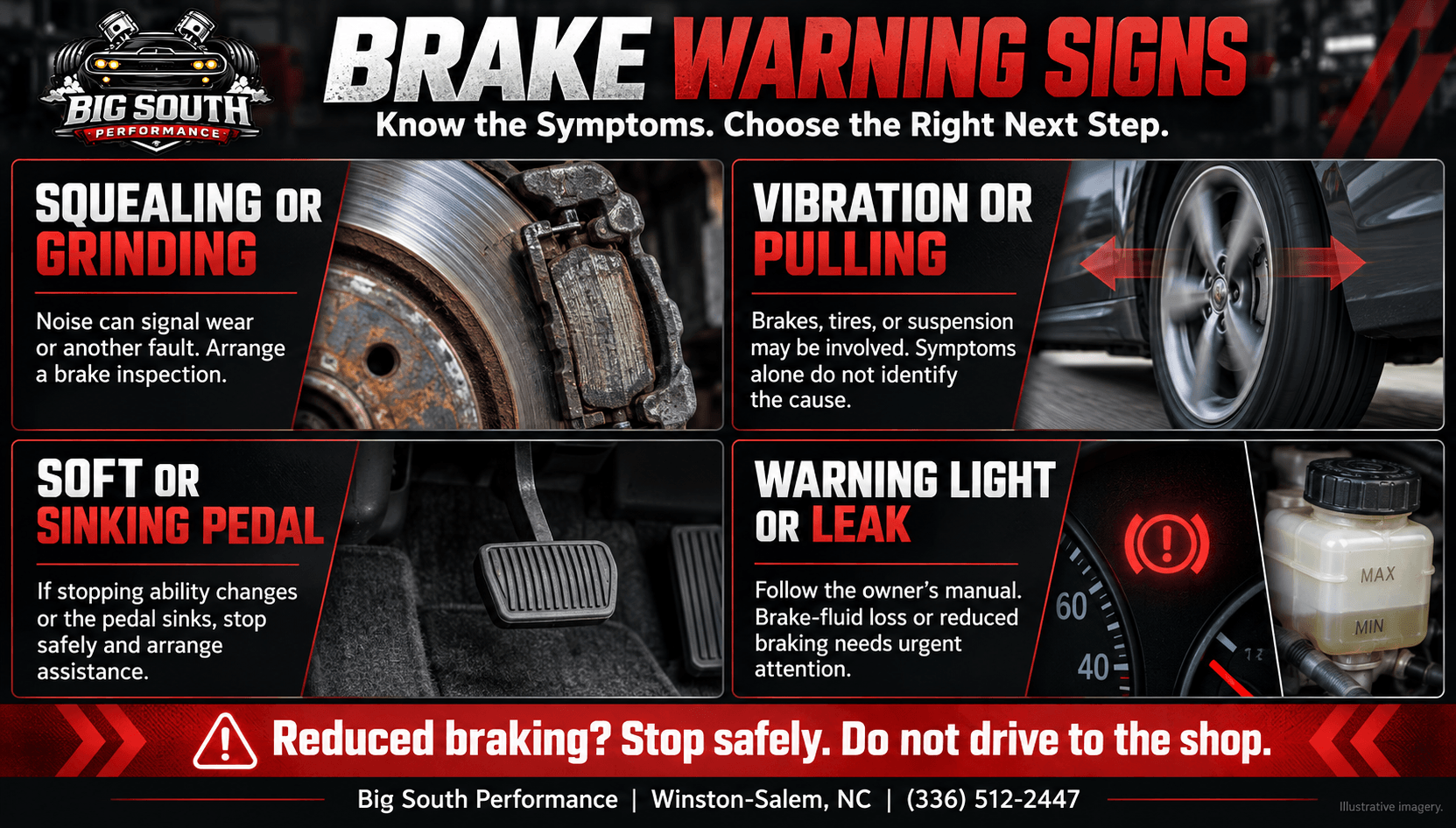
Visual Safety Guide
Recognize Brake Warning Signs
Use this overview to describe the concern. Reduced braking calls for stopping safely and arranging help.
02 / Inspect the System
Brake Service in Winston-Salem: Inspection and Repair Options
The repair scope should follow the inspection findings and the vehicle’s requirements. Discuss the categories below with Big South Performance and confirm support for the actual work. A brand name or dashboard symptom alone does not establish which repair is needed.
Brake Inspection
Request evaluation of the reported concern and the relevant braking components. Ask what the inspection includes, which measurements were taken, and whether further diagnosis is necessary. A visual glance through a wheel may not reveal every condition that affects a repair decision.
Brake Pads and Rotors
Discuss replacement when wear, damage, or other findings justify it. The correct parts depend on the vehicle and installed brake package. Ask whether the recommendation covers the front axle, rear axle, or both, and why each component needs attention.
Calipers, Hardware, and Uneven Wear
Uneven pad wear or a dragging brake can require attention beyond new friction material. Ask whether the surrounding components explain the wear pattern. Replacing pads without addressing a confirmed underlying fault can leave the original concern unresolved.
Fluid, Pedal, and Warning-Light Concerns
Describe fluid loss, abnormal pedal travel, or the exact warning message. These concerns may require hydraulic or electronic diagnosis. Confirm the appropriate procedure and system support before booking; a fluid change alone is not a substitute for repairing a leak or identifying a fault.
Confirm availability for electronic parking brakes, ABS-related diagnosis, drum brakes, specialized brake packages, and hybrid or electric vehicles. This guide does not establish support for every system.
03 / Understand the Recommendation
Do You Need Brake Pads, Rotors, or Both?
The decision depends on pad condition, rotor measurements, damage, and the applicable service instructions. A pads-only repair is not automatically wrong, and replacing every rotor at every pad change is not a universal rule. Ask for the findings that support the proposed scope.
A brake pad provides friction material; a brake rotor, also called a disc, is the surface the pads act against. These components work together, but they do not always reach their service limits at the same time.
| Proposed work | What should support it? | What should you ask? |
|---|---|---|
| Pad replacement | Pad wear or another confirmed pad concern, with rotor and system condition evaluated. | Are the rotors suitable for continued service under the applicable specifications? |
| Pads and rotors | Rotor limits, damage, or other findings requiring replacement, alongside suitable new pads. | What measurements or damage explain the recommendation? |
| Rotor resurfacing | A permitted procedure with sufficient material remaining and no condition requiring replacement. | Is resurfacing permitted, appropriate, and available for this brake design? |
| Additional component repair | A confirmed fault involving hardware, caliper operation, hydraulics, or another component. | How does this fault relate to the symptom or wear pattern? |
Why does minimum rotor thickness matter?
Rotors have service limits that must be checked against the correct specifications. Brembo identifies rotor thickness at or below the manufacturer’s minimum, along with certain damage conditions, as replacement considerations. The decision should be based on the actual component, not a guessed mileage interval.
Should new rotors receive new pads?
Ask the shop about the compatible pad-and-rotor combination and the applicable installation guidance. Brembo recommends replacing pads when replacing discs. That recommendation does not mean every pad replacement automatically requires new rotors; rotor condition still needs evaluation.
04 / Fluid and Controls
What About Brake Fluid, ABS, and Parking-Brake Warnings?
Fluid maintenance and warning-light diagnosis are different tasks. Brake fluid transmits pressure in a hydraulic system. Fluid service follows the vehicle’s requirements; a leak, abnormal pedal, or warning message needs evaluation of the underlying concern.
Brake Fluid Service
Use the exact fluid specification and maintenance guidance for the vehicle. Ask whether fluid service is due and which procedure is proposed. Do not choose fluid by color or assume that different specifications are interchangeable. Report an unexplained level change instead of treating a top-off as the complete repair.
Warning-Light Diagnosis
Record the exact symbol or message and whether it appears continuously or intermittently. A general brake warning and an ABS warning have different meanings. Consult the owner’s manual for your vehicle and confirm diagnostic support with the shop. A warning is not an instruction to replace pads automatically.
Electronic parking-brake systems and specialized braking configurations can require vehicle-specific service procedures. Provide the year, model, powertrain, and installed brake equipment when requesting service. Avoid resetting, bypassing, or disassembling a system to clear its warning.
05 / Plan the Repair
How Much Does Brake Service Cost?
Brake service pricing depends on the confirmed scope, vehicle, parts, and labor required. A front-pad replacement and a hydraulic repair are different jobs. A helpful estimate identifies the axle, components, related work, and any diagnostic charges.
- Inspection or diagnosis: What is included initially and what may require additional authorization.
- Front versus rear work: The axle or axles involved and the reason for each recommendation.
- Parts and materials: Pads, rotors, hardware, wear sensors, or fluid where applicable.
- Related faults: Additional work supported by inspection findings rather than an assumed package.
- Verification: Checks needed to evaluate the reported concern after the repair.
Ask whether the estimate includes labor, required materials, taxes, and any stated warranty terms. Confirm how the team handles additional findings before work proceeds. A low advertised price is not enough to compare quotes when the included scope differs.
How long does brake service take?
Timing depends on inspection results, parts availability, repair access, and workload. Specialized systems or additional faults may change the appointment. Explain transportation needs when booking and request a time estimate for the confirmed work. Do not assume every brake concern can be resolved during one short visit.
06 / Your Next Steps
How Do You Request Brake Service?
Send the vehicle details and current symptoms, then wait for the team to confirm the appropriate appointment. Big South Performance’s contact page explains that a submitted request is reviewed before scheduling is confirmed.
- Identify the vehicle. Include year, make, model, powertrain, mileage, and any known brake modifications.
- Describe the concern. Explain noise, vibration, pulling, pedal feel, warning messages, and when the issue occurs.
- Share service history. Include recent pad or rotor replacement, fluid work, tire service, and relevant repair records.
- Confirm safe arrival. Discuss the vehicle’s condition, service location, scheduling, and whether assistance is needed.
- Review the findings. Ask what is confirmed, which repairs are recommended, and how additional work is authorized.
After the repair, ask how the original symptom was checked and which follow-up or bedding-in instructions apply. Follow the instructions for the installed parts rather than attempting a generic hard-braking routine. Report persistent abnormal behavior instead of assuming it is normal break-in.
Vehicle-Specific Service
Find the Repair Guide for Your Make
Confirm brake-service support for your exact vehicle and installed equipment. The featured brand guides below provide broader repair information. Mention electronic parking brakes, modified components, hybrid or electric powertrains, and any special brake package at the start of the request.
Repairing Everyday Brakes or Planning an Upgrade?
This service guide focuses on inspecting and repairing the existing braking system. For a modified vehicle or a planned performance project, read Big South Performance’s brake and suspension upgrade guide. Confirm compatibility before buying parts, and address unresolved safety faults before treating an upgrade as the solution.
Questions, Answered
Brake Service FAQs
Can Big South Performance help with my brake concern?
Contact Big South Performance with the year, make, model, powertrain, and symptoms to request brake inspection or repair. Describe any warning messages and recent brake work. The team reviews vehicle and service details before confirming support and scheduling. Specialized brake packages, electronic parking brakes, and hybrid or electric configurations require confirmation for the actual task.
When should I stop driving because of a brake problem?
Stop safely and arrange assistance if stopping ability decreases, the pedal sinks abnormally, or brake-fluid loss is suspected. Smoke, a strong burning smell, or a serious braking imbalance also needs urgent attention. Follow the owner’s manual for warning messages. Do not drive to the shop or continue road testing a vehicle when braking may be compromised.
Do squeaking brakes mean I need new pads?
Not necessarily. Squealing can have more than one cause, so noise alone does not establish pad wear or the required repair. Persistent sounds need inspection, particularly when they accompany vibration or a change in braking. Explain when the sound occurs and whether parts were recently replaced. The recommendation should follow findings rather than a guess based on sound.
What should I do if my brakes are grinding?
Seek prompt inspection advice and describe whether grinding occurs while braking or continuously. Worn friction material, damage, debris, or another contact issue may be involved. If stopping ability or pedal behavior has changed, stop safely and arrange assistance. Avoid continuing trips to see whether the noise clears; the sound does not establish the fault or prove the vehicle is safe.
Why does my vehicle shake when I brake?
Shaking during braking needs diagnosis. Rotor condition, mounting concerns, and wheel or chassis issues can produce overlapping symptoms. Report whether you feel the vibration in the pedal, steering wheel, or whole vehicle and whether it occurs only during braking. Do not assume the rotors are warped or select replacement parts before the relevant inspection findings are available.
Can I replace brake pads without replacing the rotors?
Sometimes, provided the rotors and related components remain suitable under the applicable specifications. The decision depends on measurements, surface condition, damage, and the vehicle’s service requirements. Ask what findings support a pads-only repair or a pads-and-rotors recommendation. Pad replacement does not automatically require new rotors, but it should not bypass evaluation of the surfaces the pads contact.
Do front and rear brakes need replacement together?
Not automatically. Front and rear brake condition should be evaluated separately because wear and service needs can differ. Ask which axle needs work, what the inspection found, and whether the proposed scope follows the vehicle’s requirements. A front-brake recommendation does not establish that the rear brakes are healthy or that all four corners need the same work.
Does a soft brake pedal mean I need a fluid change?
A soft or sinking pedal needs evaluation of the cause rather than an automatic fluid-service order. Hydraulic concerns, air in the system, and other faults may require different repairs. If pedal behavior is abnormal or braking is reduced, stop safely and arrange assistance. Adding or replacing fluid does not repair a leak or identify every reason for abnormal pedal travel.
Does an ABS light mean the brake pads are worn?
No. An ABS warning does not by itself identify worn pads. It signals a concern involving the anti-lock braking system that needs vehicle-specific interpretation and diagnosis. Consult the owner’s manual and report the exact warning. If another brake warning appears or stopping ability changes, stop safely and seek assistance. Confirm support for the necessary diagnostic work before booking.
How often should brake pads and fluid be serviced?
Follow the exact vehicle’s maintenance guidance and inspect wear based on condition. Pad life varies with driving, use, and the installed brake system; one mileage figure does not fit every vehicle. Fluid requirements also depend on manufacturer guidance. Bring service records and current mileage so due maintenance can be discussed separately from a noise, warning-light, or pedal complaint.
How much does brake service in Winston-Salem cost?
The estimate depends on the vehicle, diagnostic findings, axle or axles involved, parts, and related work. Ask whether inspection, labor, hardware, sensors, fluid, and taxes are included where applicable. Quotes are most useful when the scope is clear. Contact Big South Performance with vehicle details to discuss the next step rather than assuming one price covers every brake concern.
How do I book a brake service appointment?
Call Big South Performance at (336) 512-2447 or submit the contact form with your vehicle details and symptoms. Include recent work and the current vehicle condition. Submitting a request does not confirm an appointment. Wait for the team to confirm support, scheduling, and the service location. If braking is compromised, arrange assistance rather than driving to the appointment.
Big South Performance • Winston-Salem, NC
Request Brake Inspection and Repair
Explain what changed, send the vehicle details, and discuss the appropriate next step with Big South Performance. Confirm the inspection scope, appointment, and location before visiting.
Reduced braking, abnormal pedal behavior, or suspected brake-fluid loss? Stop safely and arrange assistance. A submitted form is a request, not a confirmed appointment.
Technical Sources and Information Limits
General technical information checked October 8, 2026. Vehicle-specific service limits, procedures, warning-light responses, and maintenance requirements must come from the applicable owner’s manual and repair information. These references do not diagnose your vehicle or establish the shop’s support for every brake system.
- Brembo: Rotor Replacement Considerations and Bedding In
- Brembo: Brake Noises and Vibrations
- Bosch: Braking Systems and Component Information
- Ford: Brake System Warning Lamp Guidance
Business and appointment information: About Big South Performance and Contact and Service Requests. Manufacturer references provide general context; use guidance for your exact vehicle. Brand names do not imply manufacturer affiliation.