
Big South Performance • Winston-Salem, NC
Check Engine Light Diagnostics in Winston-Salem, NC
A warning light should lead to answers before a parts order. Big South Performance provides automotive diagnostics and repair support in Winston-Salem, helping you understand the fault and the appropriate next step.
Request check engine light diagnostics when the light stays on, returns after a reset, or appears with rough idle, hesitation, or reduced power. Tell the team what changed, when it happens, and whether the vehicle has recent repairs or modifications. Testing should establish the cause before repair, programming, or performance work is recommended.
Contact the team to confirm vehicle support, appointment availability, and the service location before visiting. A service request does not confirm an appointment or establish that the vehicle is safe to drive.
Quick Answer
What should you do when the check engine light comes on?
Arrange diagnosis promptly and record the warning, symptoms, and conditions when it appeared. A steady light does not identify a failed part or guarantee that driving is safe. A flashing light can indicate a misfire that may damage the catalytic converter. Reduce engine load, pull over safely, and seek urgent advice; severe shaking, overheating, smoke, or major power loss can require towing. Follow the response specified in your vehicle’s owner’s manual.
01 / Understand the Warning
Is a Steady or Flashing Check Engine Light More Urgent?
A flashing check engine light generally needs more urgent attention because it can indicate a catalyst-damaging misfire. A steady light still calls for diagnosis, even if the vehicle feels normal. The light’s behavior, the vehicle’s symptoms, and the owner’s manual together guide the immediate response.
Steady Check Engine Light
Schedule diagnosis promptly. Note whether the warning appeared after refueling, during a cold start, in traffic, or under acceleration. Avoid assuming that a steady light is only a loose gas cap. Some monitored faults affect emissions or engine operation before the driver notices a change.
Flashing Check Engine Light
Reduce engine load and avoid hard acceleration. Pull over safely and seek urgent guidance. If the vehicle shakes severely, loses substantial power, overheats, or seems unsafe, stop operating it and arrange assistance. Continuing to load a misfiring engine can make the damage worse.
What if another warning appears at the same time?
An oil-pressure warning, overheating message, or braking concern requires its own response. Do not use the check engine light’s steady appearance as permission to ignore another warning. Follow the owner’s manual and stop safely when a serious operating problem is present. Do not open a hot cooling system or keep driving simply to see whether the light turns off.
This page cannot assess your vehicle remotely. Dashboard symbols and manufacturer instructions vary; check the manual for your exact model.
02 / Diagnose Before Replacing
What Does Check Engine Light Diagnostics Involve?
Diagnosis combines the reported symptom with stored fault information, relevant operating data, and targeted testing. A scan helps choose the next test; the test helps establish the repair. Big South Performance’s live service information emphasizes reviewing the vehicle, explaining recommendations, and choosing work around its actual condition.
Document the Concern
Describe the warning and symptoms. Record available fault codes and the circumstances that triggered the concern before information is cleared.
Review the Evidence
Relevant scan information may include stored or pending codes, freeze-frame conditions, live data, and readiness status, depending on the vehicle.
Test the Suspected Cause
Use the findings to guide inspection and vehicle-specific tests. A fault involving a sensor circuit does not automatically prove the sensor has failed.
Plan and Verify
Review the supported repair recommendation and required authorization. After repairs, appropriate checks evaluate operation and the original complaint.
Some concerns are straightforward; others require additional diagnostic time or conditions that reproduce an intermittent fault. Ask what the initial appointment includes, which systems can be evaluated, and how further testing is authorized. The process above is a diagnostic framework, not a promise that every vehicle receives the same tests or reaches a confirmed answer in one visit.
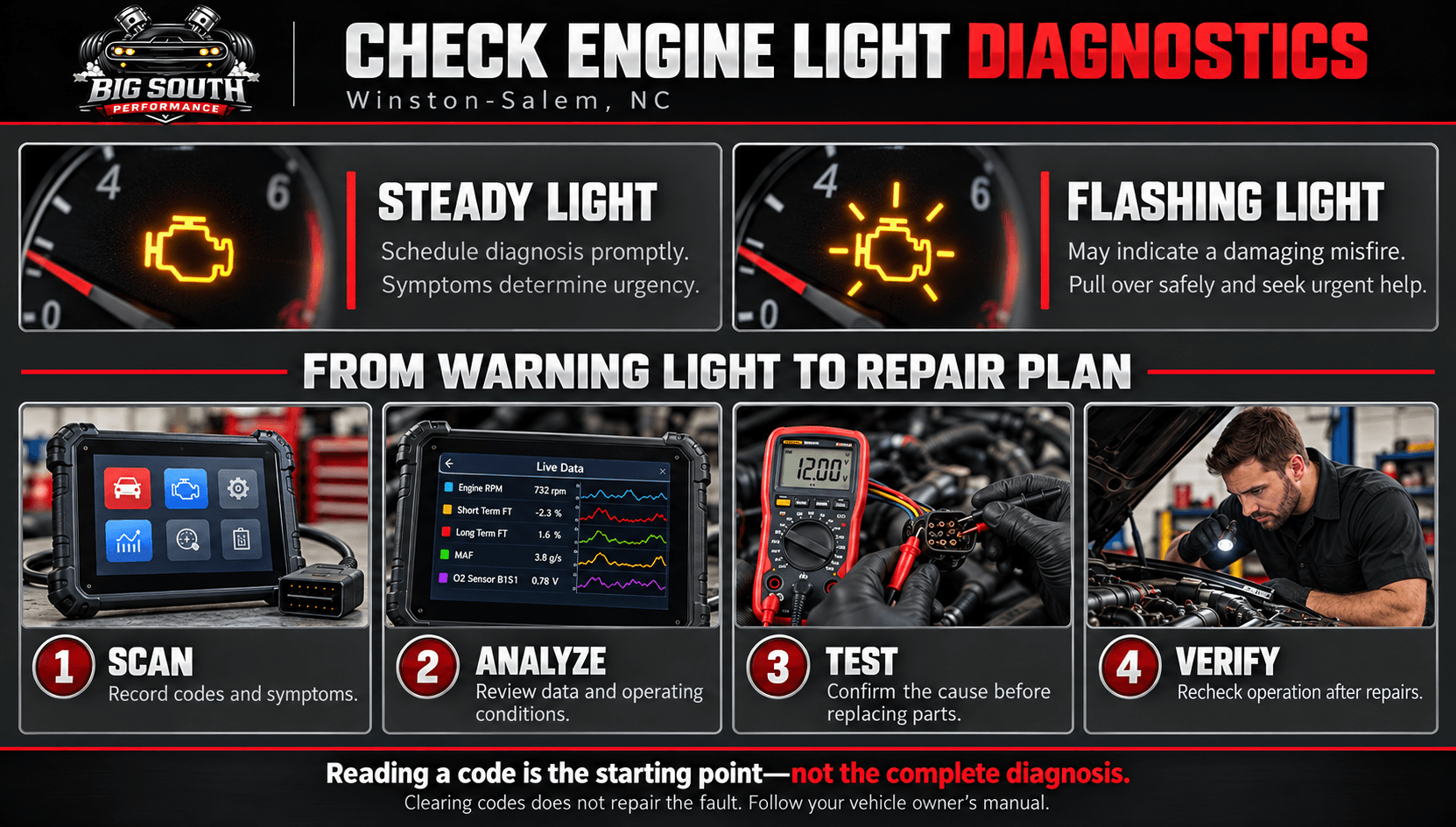
Visual Diagnostic Guide
From Warning Light to Repair Plan
Compare warning-light urgency and the steps used to investigate a fault. A scan is the starting point; testing supports the repair decision.
03 / Describe What Changed
Which Problems Can Trigger a Check Engine Light?
Possible causes include ignition, fuel delivery, air-metering, evaporative-emissions, sensor-circuit, and other monitored powertrain faults. Similar symptoms can come from different systems. A vehicle that idles roughly may need a different diagnostic path from one that runs normally but stores an emissions-related code.
| What you notice | Possible evaluation areas | Useful information to share |
|---|---|---|
| Rough idle or shaking | Ignition operation, fuel delivery, air leaks, compression, or other misfire causes. | Cold or warm engine, light behavior, and whether shaking changes with engine speed. |
| Hesitation or reduced power | Airflow readings, fuel supply, ignition, boost control where fitted, or protective operating modes. | When power drops, warning messages, and recent work or modifications. |
| Light after refueling | Evaporative-emissions system, fuel-cap sealing where fitted, and related components. | Timing after refueling, difficulty starting, and whether the vehicle uses a capless system. |
| Light on with normal driving | Stored emissions-related or control-system faults that may not create an obvious symptom. | The first appearance, whether it repeats, and any available scan results. |
| Light returns after a reset | An unresolved fault, intermittent condition, or a monitor detecting the concern again. | Who cleared the codes, repairs already attempted, and time before the warning returned. |
| Warning after modifications | Installation integrity, wiring, air leaks, component compatibility, and calibration history. | A complete parts list, previous software work, and the order in which changes occurred. |
These are examples of diagnostic directions, not confirmed causes or a list of services available for every vehicle.
Does an oxygen-sensor code mean you need a new sensor?
No. A sensor-related code can involve the circuit, a wiring fault, or operating conditions that affect the reading. Depending on the code and vehicle, an air or exhaust leak, fueling problem, or another fault may need investigation. Replacing the named component before testing can leave the actual concern unresolved.
Does a catalyst-efficiency code prove the catalytic converter is bad?
Not by itself. A catalyst-efficiency code requires evaluation of the applicable system and test conditions. Related misfires, exhaust leaks, sensor behavior, and manufacturer guidance may affect the diagnostic path. A repair recommendation should explain the evidence, including whether another fault needs correction before replacement is considered.
04 / Know What You Are Booking
How Is a Code Scan Different From a Diagnosis?
A code scan retrieves information from the vehicle; a diagnosis investigates why that information was recorded. OBD-II means on-board diagnostics, a standardized system used on many modern vehicles to monitor emissions-related operation. A diagnostic trouble code, or DTC, identifies a detected condition. It is not automatically an instruction to replace a particular part.
| Service or step | What it provides | Important limitation |
|---|---|---|
| Code reading | Available trouble codes and a starting direction for investigation. | Does not establish the failed component by itself. |
| Diagnostic testing | Interpretation, inspection, and tests directed at the reported concern. | Intermittent faults may require more time or repeat operating conditions. |
| Code clearing | A reset of applicable stored information after an appropriate decision. | Does not repair the underlying fault and can reset readiness information. |
| Repair verification | Checks of the repaired system and the original complaint. | Some monitors run only under specific conditions; an immediate light-off result is not the entire assessment. |
Should you clear the codes before the appointment?
Usually, preserve the information until the shop has reviewed it. Clearing codes can remove useful stored conditions and reset readiness monitors. Do not disconnect the battery solely to turn off the light. If codes have already been cleared, explain when and why, and provide any saved screenshots. A returning light is a reason to investigate the cause, not to keep repeating resets.
For more context on when to request evaluation, read five signs your vehicle needs a diagnostic check .
05 / Plan Your Appointment
How Much Do Check Engine Light Diagnostics Cost?
Pricing depends on the vehicle, concern, and testing required. An initial diagnostic appointment and the final repair are separate decisions. Big South Performance does not publish a universal check-engine diagnostic price in the reviewed service information; contact the team for the applicable charge and scope.
Ask What the Initial Charge Includes
Confirm whether the quoted service covers code retrieval, inspection, diagnostic labor, or a defined amount of testing. Ask when further authorization is needed and whether a diagnostic charge is treated separately from repair labor.
Request a Clear Repair Estimate
After findings are available, ask which parts and labor are recommended, why each item is needed, and what is included in the estimate. Confirm materials, taxes, and any stated warranty terms rather than assuming a standard package.
How long does diagnosis take?
Timing depends on access, fault complexity, whether the symptom can be reproduced, and the appointment schedule. A persistent fault may be easier to evaluate than a warning that appears only at a specific temperature or load. Confirm the initial appointment window and how the team will communicate if additional testing or a follow-up visit is necessary.
Is diagnostic service the same as an emissions inspection?
No. Diagnosis investigates a fault; an inspection checks compliance with the applicable inspection program. Resetting a warning does not establish that a vehicle is ready for testing. Where an OBD inspection applies, incomplete readiness monitors can affect the result. Check current requirements with the inspection authority; this page does not promise inspection eligibility or a passing result.
06 / Repairs and Performance Goals
What If Your Vehicle Is Tuned, Modified, or Swapped?
A modified vehicle needs an accurate account of its hardware, software, and repair history. An intake change, engine swap, wiring alteration, or previous calibration can affect the diagnostic starting point. Explain what changed before the warning appeared so an installation issue, mechanical fault, and software concern can be evaluated in context.
Big South Performance provides both automotive repair and performance services. That makes the vehicle’s existing condition relevant to the upgrade discussion. Diagnosis should establish whether the next step is a repair, a compatible update, or further investigation. A performance tune should not be treated as a substitute for correcting an unresolved mechanical or electrical fault.
- Before tuning: Read why a check engine light should be investigated before tuning or modifying .
- For calibration goals: Discuss ECU tuning after the underlying vehicle condition is understood.
- For software questions: Review flash programming and updates ; a fault code alone does not prove an update is the solution.
Tell the team about unknown tunes, aftermarket modules, recently installed parts, and previous attempts to solve the concern. Confirm support for your specific vehicle and configuration before booking. Specialized powertrains and unusual conversions may need additional compatibility review.
07 / Make Your Request Useful
What Should You Send Before Diagnostic Service?
Send the vehicle details, current condition, warning behavior, and repair history. Specific observations are more useful than a guessed diagnosis. The Big South Performance contact form accepts vehicle information, symptoms, modifications, and supporting files so the team can review the request.
- Identify the vehicle: Year, make, model, engine, mileage, and VIN when requested through the shop’s contact process.
- Describe the light: Steady, flashing, intermittent, or accompanied by another symbol or message.
- Describe the symptoms: Rough idle, stalling, hesitation, reduced power, unusual smell, or normal operation.
- Explain the conditions: Cold start, warm idle, highway load, rain, refueling, or another repeatable pattern.
- Share existing evidence: Exact code numbers, scan screenshots, prior invoices, and recent repairs or modifications.
- Confirm arrival arrangements: Discuss whether the current condition requires towing and confirm the service location before travel.
Do not reproduce a dangerous symptom just to collect a video. A dashboard photo taken while safely parked and a clear written history can be enough to begin the conversation. Keep your original scan report if one is available; a description such as “sensor problem” omits information that can matter.
Local Diagnostic Support in Winston-Salem
Big South Performance serves Winston-Salem and the Piedmont Triad as an automotive repair and performance shop. Drivers comparing diagnostic options should confirm appointment availability, support for the exact vehicle, and the initial testing scope. Learn more about the shop’s repair and performance approach before sending your request.
08 / Common Questions
Check Engine Light Diagnostics FAQs
1. Can I drive with a steady check engine light?
A steady light does not prove that driving is safe. Review the owner’s manual and consider the vehicle’s symptoms and other warnings. Schedule diagnosis promptly if it runs normally. If the warning accompanies overheating, severe shaking, smoke, an oil-pressure warning, or major power loss, stop safely and arrange assistance. The shop cannot determine driving safety from the light alone.
2. What should I do if the check engine light flashes?
A flashing light can indicate a misfire severe enough to damage the catalytic converter. Reduce engine load, avoid hard acceleration, pull over safely, and seek urgent guidance. If the vehicle is shaking badly or operating unsafely, stop driving and discuss towing. Follow the manufacturer’s instructions for your model rather than continuing a trip to see whether the warning disappears.
3. Is a code scan the same as check engine light diagnostics?
No. A code scan retrieves available fault information; diagnostic testing investigates why the vehicle recorded it. Codes help direct inspection, data analysis, and tests, but do not always identify a failed part. Ask what the booked service includes, how much initial testing is authorized, and when the team will contact you if further diagnostic work is required.
4. Can a loose gas cap trigger the check engine light?
Yes, an improperly sealed cap can trigger an evaporative-emissions fault on vehicles that use that design. It is only one possibility, and capless systems require different considerations. Note whether the warning appeared after refueling and check the owner’s manual. Do not assume the cap explains every light, especially when the vehicle runs poorly or displays another warning.
5. Why did the light return after I replaced a sensor?
The sensor may not have been the original cause, or another fault may still be present. Wiring, installation, air or exhaust leaks, and operating conditions can affect sensor-related readings. Provide the exact original codes, replacement-part details, and the time before the warning returned. Testing should establish what remains unresolved before another component is ordered or a reset is repeated.
6. Should I disconnect the battery to reset the light?
Do not disconnect the battery solely to hide a warning before diagnosis. A reset does not repair the fault and may remove useful diagnostic information or reset readiness monitors. Preserve code reports and describe the symptoms instead. If the battery was recently disconnected for another reason, tell the team when it happened so the available information can be interpreted correctly.
7. Can a warning light be diagnosed if it has turned off?
Often, useful information may remain available, but this depends on the vehicle and fault. An intermittent concern can leave stored or pending codes, while other evidence may be limited. Record when the light appeared, the conditions, and any accompanying symptoms. Diagnosis may require additional time or a repeatable pattern; a light turning off does not prove every underlying concern has been resolved.
8. Will diagnosis tell me the final repair price immediately?
Not always. The repair estimate depends on the findings and whether further testing is needed. Confirm the initial diagnostic charge and scope before the appointment, then review the recommended parts and labor when evidence is available. Ask how additional work is authorized. A quote for diagnostic time should not be assumed to include every repair or guarantee an immediate answer.
9. Can ECU tuning fix a check engine light?
A tune is not a general repair for a warning light. Mechanical faults, wiring problems, misfires, and air or fuel concerns need diagnosis before performance calibration is considered. Big South Performance offers repair and performance services, so explain both the current symptoms and your goals. The appropriate next step depends on the confirmed condition and vehicle compatibility, rather than the warning alone.
10. How do I book check engine light diagnostics at Big South Performance?
Call (336) 512-2447 or send a request through the contact page with the vehicle’s year, make, model, engine, warning behavior, symptoms, and recent work. Attach available code reports or safely taken dashboard photos. The team reviews your details before confirming service. Confirm the appointment and location, and discuss towing if the current condition makes driving unsafe.
Start With the Fault, Then Choose the Repair
Request Check Engine Light Diagnostics
Tell Big South Performance what the warning light is doing and how the vehicle feels. A useful service request starts with the symptoms, fault information, and vehicle history so the team can review the next diagnostic step.
Appointments are confirmed after the team reviews the request. Confirm the service location before visiting; arrange assistance if the vehicle is unsafe to drive.