Big South Performance • Winston-Salem, NC

Honda Repair in Winston-Salem, NC: Performance & Tuning

Big South Performance provides Honda repair in Winston-Salem, including general maintenance, diagnostics, and compatible performance upgrades. Bring us an everyday service concern or discuss ECU tuning, performance parts, and a turbocharger project for a supported application.

Good repair work starts with finding the cause. Good performance planning starts with a healthy vehicle and a complete combination of parts, calibration, and supporting systems. Our Honda service approach connects those priorities so you can discuss both reliability and your next upgrade with one shop.

Big South Performance Honda repair and performance tuning banner with an illustrated red Civic and silver SUV.
Honda repair and performance services. AI-generated promotional illustration.

Choose Your Honda Service Path

Restore reliability

Repair & Diagnosis

Warning lights, rough running, brake concerns, leaks, or unusual noises? Start by identifying the problem before replacing parts or changing software.

Explore Honda repair

Keep up with care

Maintenance

Service reminders or an unclear maintenance history? Review the model-specific requirements and establish what has been completed and what is due.

Plan Honda maintenance

Build with a purpose

Performance & Tuning

Planning parts, calibration, or forced induction? Confirm vehicle compatibility, mechanical readiness, supporting work, and your intended use first.

Discuss Honda performance

Daily drivers welcome

Honda Repair & Diagnostics: Find the Cause First

A fault code, noise, or vibration helps narrow the investigation; it does not automatically identify a failed part. Similar symptoms can arise from different systems. Useful diagnosis considers the complaint, service history, operating conditions, and relevant testing.

Check Engine Light & Rough Running

Tell us whether the warning is steady or flashing, whether the engine shakes, and when the problem appears. A concern during a cold start may require a different investigation from hesitation under acceleration. Recent repairs, fuel changes, and modifications are important context.

Brakes, Steering & Suspension

Describe whether vibration occurs while braking, at a particular speed, or over bumps. Brake components, tires, wheels, and suspension can produce overlapping complaints. Inspection should identify the relevant wear or fault rather than treating every vibration as the same problem.

Leaks & Cooling-System Concerns

Note where fluid appears, whether the level repeatedly falls, and whether engine temperature changes. Locating the source matters: fluid can travel before reaching the ground. Repeated overheating requires evaluation before normal driving or performance upgrades continue.

Modified-Honda Drivability

A rough idle, hesitation, or inconsistent power after an upgrade may involve installation, sensors, fuel delivery, air leaks, or calibration. Provide the complete parts list and current tuning information so the hardware and software can be assessed together.

What Your Symptoms Tell Us to Investigate

These are starting points for a service enquiry, not diagnoses or a claim that every Honda develops these problems.

Honda service enquiry guide
What you notice Useful details to share Appropriate next step
Check engine light or rough idle Steady or flashing light, cold or warm engine, recent work, stored codes if known Diagnosis before parts replacement or performance tuning
Vibration while braking Speed, pedal or steering-wheel vibration, pulling, recent tire or brake work Brake, wheel, tire, and suspension assessment as indicated
Coolant loss or temperature rise Fluid location, warning messages, frequency, and conditions when it occurs Locate the cause and assess vehicle readiness
Hesitation after modifications Parts installed, software changes, fuel used, and when the issue began Review hardware, installation, and calibration together
Service reminder with no symptoms Maintenance codes, mileage, time since service, and completed work Match due items to the correct Honda maintenance guidance

When to stop driving: Pull over safely for overheating, an oil-pressure warning, serious brake loss, or a flashing check engine light accompanied by severe rough running. Continuing can worsen damage or compromise control. Arrange safe transport rather than driving the vehicle to the shop.

Honda Maintenance Minder & Model-Specific Service

Honda maintenance should follow the correct owner’s manual, service history, and vehicle condition. On equipped vehicles, Maintenance Minder displays calculated remaining engine-oil life and service-item codes. The oil-life percentage is a maintenance estimate, not a measurement of how much oil is in the engine.

Read the Complete Reminder

A reminder can identify more than an oil change. Honda’s codes may include inspections, filters, transmission fluid, spark plugs, coolant, or other applicable items. Meanings and additional requirements must be checked against the exact model, year, and market.

Save a photograph of the full display before the reminder is reset. Resetting a code does not complete the associated service.

Match Fluids to the Drivetrain

Manual, conventional automatic, CVT, and hybrid applications should not be treated as interchangeable. Use the specifications for the actual vehicle and transmission. For example, Honda’s 2026 Civic hatchback guidance lists different fluids for CVT and manual-transmission configurations.

Bring previous invoices so a recommendation can account for what was used and when it was changed.

Check Time-Based Requirements

Low annual mileage does not remove every maintenance requirement. Honda manuals can specify time-based services in addition to displayed reminders. Confirm your vehicle’s requirements instead of waiting for one universal mileage interval.

Review an Unclear Service History

For a recently purchased Honda, separate documented maintenance from assumptions. Establish completed fluid services, inspections, and applicable major engine-service items. A baseline assessment can help prioritize immediate work and future care.

Find your Honda owner’s manual and share the service codes or records with your enquiry.

Model matters. Configuration matters more.

Honda Model Guide: Repair, Maintenance & Upgrade Priorities

A model name does not identify every service requirement. Honda powertrains and equipment vary across years and trims. The sections below explain useful priorities for each enquiry; Big South must confirm the requested repair or tuning support for your exact configuration.

Honda Civic, Civic Si & Civic Type R

Repair priority: Identify the generation, engine, and transmission before choosing parts or maintenance. For rough running, distinguish a starting or idle problem from hesitation under load. Include any intake, exhaust, turbo, or software changes.

Performance priority: A Civic commuter, Si, and Type R need different build assessments. Factory-turbo and naturally aspirated applications are also different starting points. Evaluate calibration access, cooling, fuel, and drivetrain capability before setting an output target.

Bring: Year, trim, engine details, transmission type, parts list, current tune, and intended street or other use.

Honda Accord

Repair priority: Identify whether your Accord has a gasoline or hybrid powertrain and which transmission it uses. Diagnose hesitation, warning lights, fluid concerns, or vibration in the context of that configuration.

Performance priority: Gasoline engines and hybrid systems cannot be grouped under one tuning promise. A proposed parts combination needs a platform-specific review. Hybrid or high-voltage work requires separate capability confirmation.

Bring: Year, powertrain, service history, fuel used, existing modifications, and whether the goal is repair, response, or additional performance.

Honda CR-V

Repair priority: Preserve dependable everyday operation by following the correct maintenance guidance and investigating new noises, vibration, fluid loss, or changes in braking and acceleration.

Maintenance priority: Confirm gasoline versus hybrid configuration and whether the vehicle has AWD. Transmission and applicable rear-drivetrain service should follow the specific manual rather than a generic SUV schedule.

Bring: Year, drivetrain, service codes, mileage, and whether the concern appears during turns, at highway speed, or under acceleration.

Honda HR-V

Repair priority: Describe the operating conditions behind the complaint. A vibration at a steady speed, a suspension noise over bumps, and a hesitation during acceleration are different starting points.

Maintenance priority: Verify transmission type and applicable AWD service requirements. Honda’s model-specific reminders can include fluid services and inspections beyond the engine-oil item.

Bring: Maintenance history, reminder codes, recent tire or suspension work, and any change in how the vehicle drives.

Honda Pilot

Repair priority: Consider how the vehicle is used for passengers, cargo, and towing. Changes in braking, ride quality, cooling, or drivability should be assessed before a long trip or heavy-use period.

Maintenance priority: Confirm the engine’s applicable major service requirements and the status of transmission and AWD-related maintenance. Completed records matter more than an assumption that a previous owner handled everything.

Bring: Year, mileage, prior major-service invoices, towing use, and the circumstances behind any warning or vibration.

Honda Odyssey

Repair priority: Focus on reliable family transportation: brakes, tires, suspension, cooling, and smooth running. Explain whether a concern appears with passengers, in stop-and-go traffic, or after extended driving.

Maintenance priority: Review the service records for your exact year and engine, including applicable major engine work and transmission-fluid requirements. Avoid assigning the same schedule to every generation.

Bring: Mileage, service reminders, recent repairs, and upcoming travel needs so the requested work can be discussed clearly.

Honda Ridgeline

Repair priority: Tell us whether the truck is used for hauling or towing and whether symptoms change with a load. Brake, tire, suspension, cooling, and drivetrain condition are relevant to dependable operation.

Upgrade priority: Define the goal before choosing parts. Handling or performance modifications do not increase the manufacturer’s payload or towing ratings, and a proposed build must account for the intended load and use.

Bring: Year, service history, accessories, wheel and tire changes, and a description of typical loads.

Honda Fit

Repair priority: On an older or newly purchased Fit, establish a maintenance baseline and investigate leaks, noise, rough running, or wear before spending on upgrades.

Upgrade priority: Tires, braking condition, and suitable suspension components can be part of a handling-focused discussion. Confirm year-specific fitment, ride-height goals, and alignment needs before purchasing parts.

Bring: Year, transmission, service records, installed parts, and whether comfort, handling, or another objective is the priority.

Performance with a complete plan

Honda ECU Tuning & Performance Upgrades

Honda performance work should begin with a defined goal: improved response, a coordinated parts package, or a larger build for a specific use. Big South Performance handles tuning and performance enquiries alongside general repair, with support confirmed for the vehicle and proposed work.

An ECU tune adjusts supported engine-management calibration. A maintenance tune-up addresses service needs and running condition. If the engine misfires, overheats, or has an unresolved fault, identify and correct the cause before pursuing additional output.

Stock or Lightly Modified Honda

Discuss the intended improvement and available calibration access before buying a tuning product. An otherwise stock engine does not necessarily respond like an engine with substantial airflow or boost changes. Compatibility and potential benefits must be assessed individually.

Intake, Exhaust & Supporting Parts

Evaluate the actual parts combination rather than treating each component as an isolated gain. A change may affect airflow, sensor placement, fitment, noise, or calibration requirements. Some parts need supporting work; others may not require an ECU change.

Existing Tune or Unknown Software

Share the tuning device or platform, available files, parts list, and previous invoices. An undocumented calibration can complicate diagnosis. Establish what is installed before requesting a revision or adding more hardware.

Daily-Driver Expectations

Discuss fuel availability, heat management, cold starts, smooth low-speed operation, and maintenance needs. The most aggressive setup may not suit a Honda used for commuting or family transportation.

Honda Turbocharger Installation & Turbo Upgrade Planning

Adding forced induction to a suitable naturally aspirated engine and upgrading a factory-turbo Honda are different projects. Neither should be reduced to the price of a turbocharger. Installation, controls, fueling, heat management, and drivetrain support determine the complete scope.

Adding a Turbocharger

Evaluate engine suitability and health, available installation hardware, fuel-system requirements, charge piping, oil and cooling arrangements, calibration support, and packaging. Buying a kit before this review can leave important compatibility questions unanswered.

Upgrading a Factory-Turbo Setup

A different turbo or increased output can change airflow, fuel demand, temperature, and torque. Existing supporting components and software must be reviewed against the proposed goal. A bolt-on label does not establish that no other work is required.

Both approaches require realistic expectations for cost, drivability, maintenance, and mechanical stress. Street-use requirements and vehicle suitability should be discussed before a scope is finalized. We do not assign a universal safe boost level or guaranteed horsepower gain to every Honda.

Read about turbocharger and supercharger project planning

Is Your Honda Ready for a Performance Upgrade?

Use this checklist to prepare a consultation. The required tests depend on the vehicle and project; not every enquiry needs the same inspection package.

1. Engine & Ignition

Resolve unexplained fluid use, rough running, warning lights, or concerning noises. Review engine condition, plugs, ignition, and relevant test findings before increasing load.

2. Fuel & Air

Confirm fuel delivery, intended fuel, airflow components, and the integrity of relevant intake or boost connections. Proposed output must fit the available fuel system.

3. Cooling & Heat

Check the cooling system and consider additional heat from the proposed setup. Repeated overheating is a repair concern, not a condition to tune around.

4. Transmission & Drivetrain

Identify the transmission and evaluate its condition. Additional torque can change requirements for a clutch, transmission, axles, or other drivetrain components.

5. Brakes, Tires & Handling

Assess the equipment that helps the vehicle stop and maintain control. More output does not correct worn brakes, unsuitable tires, or damaged suspension.

6. Calibration & Documentation

Confirm ECU access and record the installed hardware. A clear build sheet helps the calibration, maintenance, and future repairs follow the same configuration.

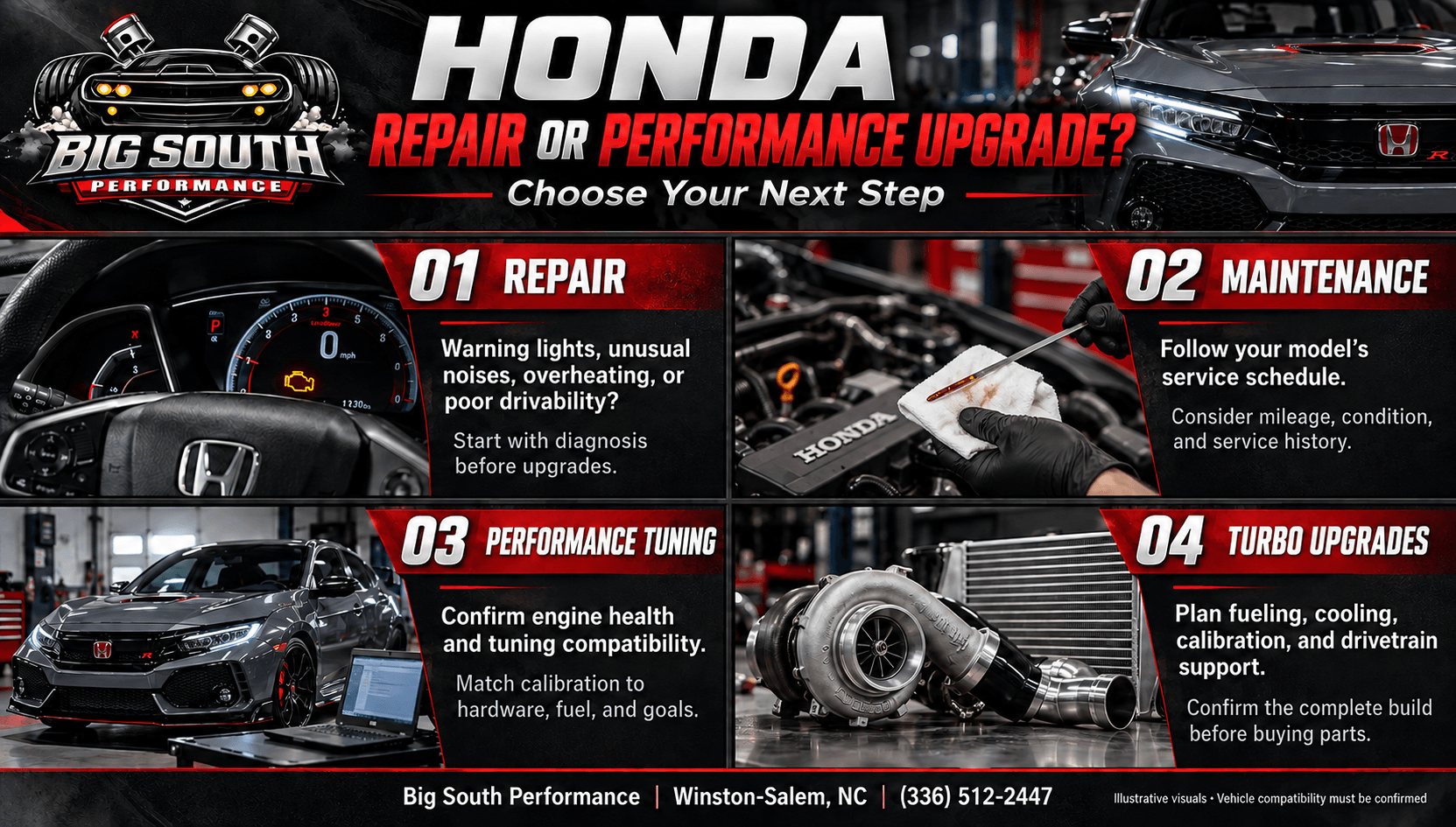
Honda Repair or Performance Upgrade? Choose Your Next Step

Diagnose a problem, complete due maintenance, confirm tuning compatibility, or establish a complete turbo plan. This guide summarizes the four paths; the sections above explain how your model and configuration change the decision.

Honda infographic explaining repair diagnosis, maintenance planning, performance tuning readiness, and turbo upgrade support.
AI-generated illustrative visuals. Repair and tuning availability must be confirmed for the specific vehicle.

Honda Repair Estimates & Performance Project Costs

Repair and upgrade estimates answer different questions. A repair estimate depends on diagnosing the concern, required parts, access, and labor. A performance estimate also needs a defined target and review of the supporting systems.

For a Repair Enquiry

  • Year, model, trim, engine, transmission, and mileage
  • Symptoms and when they occur
  • Warning messages and recent work
  • Maintenance history and available invoices
  • Whether the Honda can be transported safely

For a Performance Enquiry

  • Current hardware and software modifications
  • Proposed components and any parts already purchased
  • Intended use, fuel, and drivability priorities
  • Budget and preferred timing
  • Known mechanical issues and future build goals

Ask what the proposed scope includes, whether diagnostic work is separate, which supporting parts are required, and how changes will be discussed. Confirm warranty or service-policy terms for the specific job rather than assuming the same coverage applies to repairs and custom builds.

Honda Service in Winston-Salem & the Piedmont Triad

Big South Performance is located at 2020 Cloverdale Avenue, Winston-Salem, NC 27103 . Drivers from Winston-Salem and surrounding Piedmont Triad communities can contact the shop to discuss general Honda repair or a compatible performance project.

For enquiries from Clemmons, Lewisville, Kernersville, Greensboro, High Point, or another nearby community, confirm the appointment and project scope before traveling. Describe whether the vehicle is stock, modified, or currently experiencing a drivability problem.

One shop, two useful conversations: Explain what your Honda needs today and what you want it to do later. Repairs and maintenance can be prioritized first, while a separate upgrade plan identifies compatible parts, supporting work, and realistic next steps.

Honda Repair, Maintenance & Tuning FAQs

Does Big South Performance repair stock Honda vehicles?

Yes. General auto repair, diagnostics, and maintenance are available alongside performance services. You do not need a modified Honda to request service. Share your configuration and symptoms so the appropriate work can be confirmed.

Can you work on my Honda model and year?

Contact us with the year, model, engine, transmission, and requested work. The model guide helps prepare an enquiry, but it does not establish support for every engine, hybrid system, or specialist task.

What does a Honda Maintenance Minder code mean?

It identifies maintenance items for an equipped vehicle. Check the complete code against the correct owner’s manual, including applicable time-based requirements. The oil-life percentage is not an oil-level reading, and resetting a reminder does not complete the service.

Can a Civic Si, Type R, or Accord be tuned?

Tuning support must be confirmed for the exact year, engine, ECU, transmission, and software. Provide the installed parts and current calibration details. Support for one version does not automatically apply to another.

Does my Honda need tuning after an intake or exhaust upgrade?

Not every component requires a calibration change. The answer depends on the hardware, sensors, vehicle, and complete configuration. Review the proposed combination before buying or installing parts.

Can tuning fix a check engine light?

A check engine light needs diagnosis. Mechanical, electrical, installation, or calibration problems can produce similar symptoms. Repair the underlying cause; do not treat a performance tune as a substitute for diagnosis.

Can you install a turbocharger on my Honda?

A compatible project may be evaluated. Engine health, fuel delivery, cooling, available hardware, calibration, drivetrain condition, and intended use determine whether the work can be supported and what is required.

How much horsepower will a Honda tune or turbo add?

There is no universal figure. Results vary by engine, parts, fuel, mechanical condition, calibration, and measurement method. Discuss expectations for your actual configuration rather than relying on a generic advertised gain.

Can I use parts I already purchased?

Contact us before delivery or installation. Fitment, completeness, condition, compatibility, and supporting requirements need review. Customer-supplied parts do not automatically establish installation availability or warranty coverage.

Does Big South handle Honda recalls?

Recall information should be checked through Honda using the vehicle’s VIN. Follow Honda’s instructions for arranging any recall remedy. A general repair appointment does not replace the manufacturer’s recall process.

Official Honda Owner Resources

Use the manufacturer’s information for your exact vehicle when checking maintenance requirements, specifications, and recall status.

Maintenance references: 2024 HR-V Maintenance Minder and 2026 Civic hatchback transmission-fluid guidance . These are examples, not universal specifications for all Hondas.

Repair your Honda. Plan your next upgrade.

Request Honda Repair in Winston-Salem

Tell Big South Performance what you drive, what has changed, and what you want to accomplish. Start with a repair assessment, discuss due maintenance, or request a consultation for compatible Honda tuning and performance upgrades.

Visit: 2020 Cloverdale Avenue, Winston-Salem, NC 27103
Call: (336) 512-2447
Email: bigsouthperformance@gmail.com

Explore other makes • ECU tuning • Turbo project planning