
Big South Performance • Automotive Air Conditioning
Auto AC Repair in Winston-Salem, NC
Warm air from the vents, weak airflow, or cooling that disappears in traffic can make every trip uncomfortable. For auto AC repair in Winston-Salem, contact Big South Performance with your vehicle details and symptoms so the team can review the requested diagnosis and repair.
A useful repair plan starts by separating an airflow problem from a cooling problem. Adding refrigerant, replacing a compressor, or changing a cabin filter addresses different faults. Describe what has changed, whether the concern is constant, and any recent AC work before deciding which service to request.
Contact the team to confirm vehicle support, the service location, and appointment availability before visiting.
Quick Answer
What should you do when your car AC stops cooling?
Request AC diagnosis before assuming the system needs a recharge. Warm air, weak airflow, and intermittent cooling can have different causes. Record the symptoms and disclose previous refrigerant additions or repairs. A recharge changes the amount of refrigerant; it does not repair a leaking component. Call Big South Performance at (336) 512-2447 to discuss the appropriate next step for your vehicle.
01 / Understand the Symptoms
Which Car AC Symptoms Need Diagnosis?
A change in temperature, airflow, noise, or operating pattern is worth describing when you book. “The AC does not work” is a starting point, but details help narrow the concern. Does air move normally? Is it warm from every vent? Does cooling return while driving? Use the guide below to organize those observations without treating them as a diagnosis.
| Symptom | Areas that may need evaluation | Helpful detail to record |
|---|---|---|
| Air blows, but stays warm | Refrigerant circuit, compressor operation, temperature controls, and heat rejection. | Whether all vents are affected and whether the change was sudden or gradual. |
| Very little air from the vents | Cabin filter, blower operation, ducts, and airflow controls. | Which fan speeds and vent settings work. |
| Cooling comes and goes | Operating conditions, controls, electrical inputs, and system performance. | How long cooling lasts and what happens before it stops. |
| Cooler while driving than at idle | Condenser airflow, cooling-fan operation, and refrigerant-system performance. | Whether the engine temperature also changes. |
| One side feels warmer | Zone settings, air-mixing controls, and vehicle-specific system operation. | Driver versus passenger side and the selected temperatures. |
| New noise when AC is selected | Blower, drive components, compressor, and nearby components. | Where the noise seems to come from and whether it follows fan speed. |
These are possible inspection areas, not confirmed faults. Symptoms can overlap, and the exact vehicle determines the testing procedure.
Why is my car AC blowing warm air?
Warm air means the system is not delivering the cooling you expect; it does not identify a failed part. Begin by confirming the selected temperature and AC setting. If the concern remains, share the operating pattern and service history. Avoid buying a compressor solely because the air is warm.
Why is the airflow weak?
Weak airflow calls for attention to the ventilation path as well as cooling performance. A restricted cabin filter is one possible issue, but the blower and airflow controls may also need evaluation. Note whether air is weak at every speed or only certain settings. A refrigerant recharge does not correct a blocked filter.
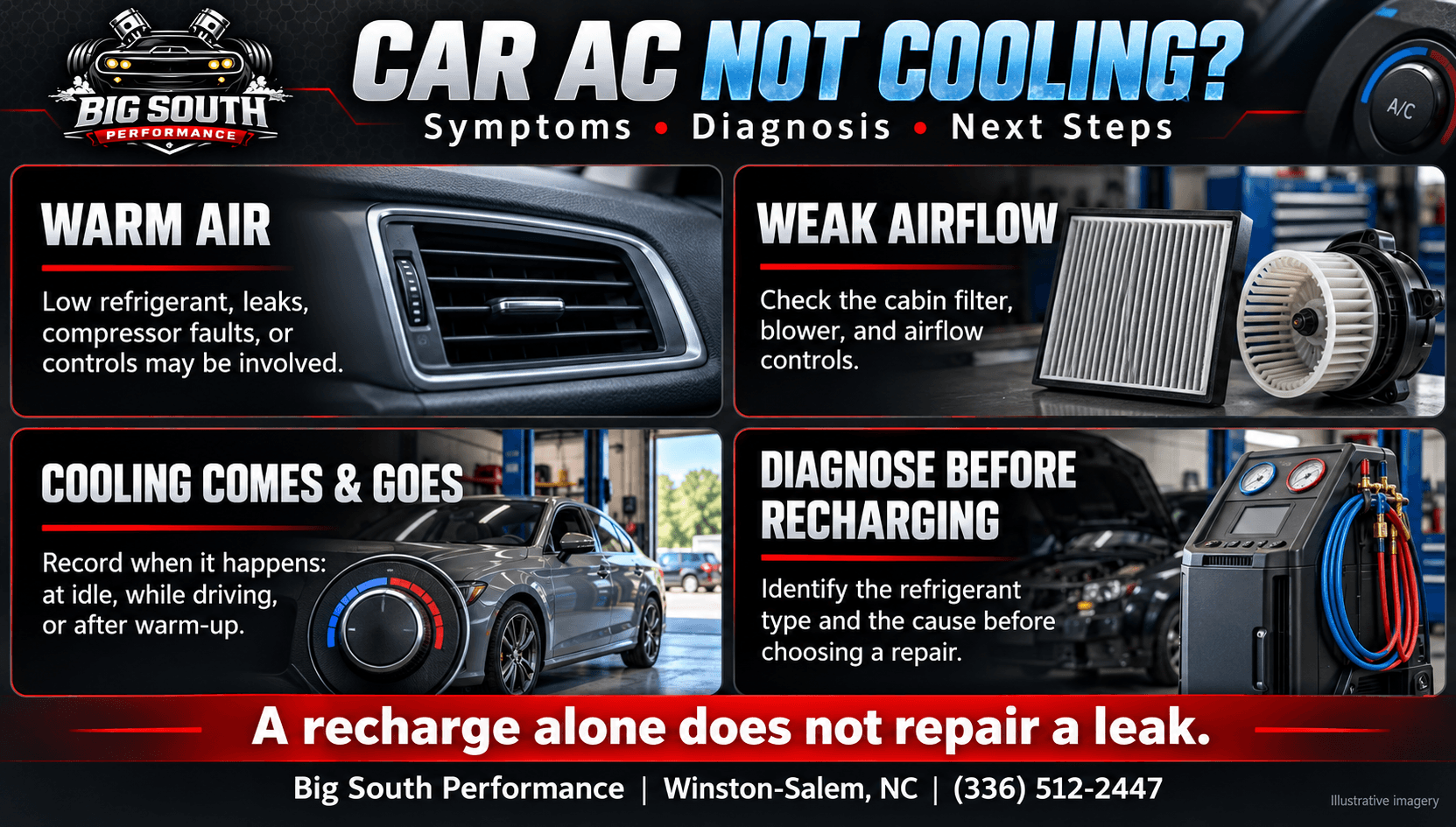
Visual Service Guide
Car AC Not Cooling? Start Here.
Compare your symptoms, then discuss diagnosis before selecting a repair.
02 / Explore Service Options
Auto AC Repair in Winston-Salem: Diagnosis and Repair Options
The appropriate service depends on the confirmed problem and the vehicle’s AC design. Big South Performance’s service request form allows you to send vehicle details, symptoms, recent work, and supporting photos. The team reviews the request before confirming an appointment. Discuss the following service categories and ask which are appropriate and available for your vehicle.
Cooling Performance Diagnosis
Describe the cooling concern, when it happens, and which settings you use. A vehicle-specific evaluation can distinguish refrigerant-circuit concerns from airflow and temperature-control issues. Ask what the diagnostic appointment covers and whether further testing requires separate authorization.
Refrigerant Leak Evaluation
If refrigerant loss is suspected, discuss leak evaluation rather than repeatedly requesting a top-off. The location and severity of a leak affect the repair plan. An intermittent or difficult-to-access leak may require additional investigation before a specific component can be identified.
Airflow and Control Concerns
Report inoperative fan speeds, air coming from the wrong vents, or different temperatures between zones. The requested work may involve ventilation components or controls rather than refrigerant. A precise symptom description helps keep the conversation focused on the actual concern.
Component Repair Planning
Once a fault is identified, ask which parts, related materials, and follow-up checks are included. A compressor, condenser, hose, or control repair has a different scope. Fitment and manufacturer instructions matter; a replacement part should match the exact vehicle configuration.
This guide explains service considerations. It does not establish that every refrigerant type, repair procedure, hybrid system, or electric vehicle is supported.
03 / Choose the Right Approach
Does Your Car Need AC Repair or a Recharge?
AC repair addresses a fault; a recharge addresses refrigerant quantity. The two may be part of the same job, but they are not interchangeable. If a leak or another fault remains, adding refrigerant alone may leave the reason for poor cooling unresolved.
The EPA explains that topping off or recharging does not permanently fix refrigerant leaks. It also notes that an incorrect charge can impair performance. Ask why refrigerant service is being recommended and what findings support the proposed work.
| Service | Purpose | Question to ask |
|---|---|---|
| Diagnosis | Evaluate the concern and establish the next testing or repair step. | What has been confirmed, and what remains uncertain? |
| Leak repair | Address an identified leaking component or connection. | Where is the leak, and what does the repair include? |
| Recovery and recharge | Service refrigerant quantity using the applicable procedure. | Is the refrigerant and specified charge correct for my vehicle? |
| Airflow or control repair | Address a confirmed ventilation or control fault. | How does this finding explain the symptom I reported? |
Tell the shop about previous DIY recharge products, stop-leak additives, or unknown refrigerant. That history can affect the service approach. Keep receipts or packaging information if available, and avoid adding more products before the request has been reviewed.
04 / Your Next Steps
How Do You Start an AC Service Request?
Send the vehicle details first, then wait for the team to confirm the service and appointment. Big South Performance’s contact page describes a request-review process. Submitting the form does not reserve a confirmed appointment.
- Identify the vehicle. Include year, make, model, engine or powertrain, and mileage. Provide the VIN through the service form if requested.
- Explain the symptom. Describe air temperature, airflow, noises, affected vents, and whether the concern occurs at idle or while driving.
- Disclose previous work. Include AC repairs, refrigerant additions, collision repairs, electrical work, and relevant modifications.
- Confirm the next step. Ask about diagnostic authorization, vehicle support, the service location, and scheduling.
- Review the proposed scope. Discuss the findings, recommended repairs, estimate, and any additional investigation before authorizing further work.
After repairs, ask how the original concern was checked. If the symptom occurred only after a long drive or in particular conditions, explain that before the appointment so the verification discussion reflects your experience.
05 / Plan Your Visit
How Much Does Car AC Repair Cost?
The estimate depends on the diagnosis, vehicle, parts, access, and required refrigerant service. A weak-airflow complaint and an inaccessible leaking component can lead to very different scopes. A useful estimate explains what is included rather than treating every cooling complaint as the same repair.
- Diagnostic scope: Initial evaluation versus additional testing needed to isolate the fault.
- Vehicle configuration: Model year, powertrain, AC layout, and any rear or multi-zone system.
- Repair requirements: Component access, correct replacement parts, and related materials.
- Refrigerant service: Applicable refrigerant type, quantity, and service procedure.
- Verification: Checks needed to evaluate the original symptom after the work.
Ask whether the diagnostic charge is separate, how additional work is authorized, and whether the estimate includes the complete proposed repair. Do not assume a quoted recharge price includes leak repair or component replacement.
How long will the appointment take?
Timing depends on testing, repair access, parts availability, and workload. Intermittent symptoms may need more observation than a constant fault. Describe transportation needs when booking, and obtain a time estimate for the confirmed scope rather than relying on a universal same-day promise.
06 / Vehicle-Specific Support
Which Vehicles Can You Ask About?
Contact Big South Performance with the exact vehicle and requested AC work to confirm support. The website features the following brand guides. They provide broader repair information; this page focuses on air conditioning concerns.
Does the refrigerant type matter?
Yes. The vehicle’s specified refrigerant and service requirements matter. Do not assume R-134a and R-1234yf are interchangeable, or choose refrigerant by the appearance of a can. Share the vehicle details and any refrigerant label information when discussing service. Confirm support for the actual system before booking.
What about hybrids, electric vehicles, and modified cars?
Identify these configurations at the start of the request. Specialized systems and modified installations can change the required equipment, access, and procedures. A brand listing does not establish compatibility with every powertrain or custom AC setup. Provide installation history if the engine, electrical system, or AC components have been changed.
Safety Comes First
When Should You Stop and Seek Help?
Stop safely if an AC complaint occurs with overheating, smoke, a burning smell, or a serious new mechanical noise. Do not continue driving solely to test whether cooling returns. Follow the owner’s manual for warning messages and arrange help when the vehicle may be unsafe to operate.
Cooling loss without other symptoms may be primarily a comfort concern, but poor windshield visibility or uncomfortable heat can still make a trip unsafe. Assess the conditions before continuing. Do not reach near moving belts or fans, open hot cooling-system components, or attempt to release refrigerant.
For a simple observation, note the selected AC settings and whether airflow changes with fan speed. Leave pressurized-system work to appropriately trained personnel. The EPA publishes requirements for paid automotive refrigerant service, including technician certification and approved refrigerant-handling equipment.
How Can You Prepare for the Appointment?
A short symptom history is more useful than a guessed diagnosis. Record when cooling changed, how often it happens, and what restores normal operation. Note whether the concern affects front and rear vents, changes with fan speed, or began after another repair. Take photos of displayed warnings while parked safely.
Bring relevant service records and disclose any products previously added to the AC system. Use the maintenance schedule for the exact vehicle when reviewing cabin-filter service; do not assume one replacement interval fits every model and driving environment. Ask the team what preparation is needed for the confirmed appointment.
For a Winston-Salem service visit, confirm the appointment and location directly with the team. If the vehicle also has warning lights or drivability problems, mention them rather than submitting only an AC complaint.
Questions, Answered
Auto AC Repair FAQs
Can Big South Performance help with my car AC problem?
Contact Big South Performance with your year, make, model, powertrain, and AC symptoms to request diagnosis or repair. The team reviews vehicle and service details before confirming an appointment. Support must be confirmed for the actual system, especially for specialized refrigerants, hybrid or electric vehicles, and modified installations. Call (336) 512-2447 or submit the service request form.
Why is my car AC blowing warm air?
Warm air can involve the refrigerant circuit, compressor operation, heat rejection, or temperature controls. The symptom alone does not establish which part has failed. Check the selected settings, then record whether every vent is affected and whether cooling changes while driving. A vehicle-specific diagnosis is the next step before selecting replacement parts or adding refrigerant.
Does warm air always mean low refrigerant?
No. Low refrigerant is one possible explanation, but warm air can have other causes. Adding refrigerant without identifying the problem may leave the original fault unresolved. Tell the shop about previous recharge attempts and whether they changed the symptom. Ask what findings support refrigerant service and whether a separate airflow, control, or component problem needs attention.
Will an AC recharge repair a refrigerant leak?
No. A recharge can change refrigerant quantity, but it does not repair the component or connection allowing refrigerant to escape. If a leak is present, discuss its location and the recommended repair. Ask whether the estimate covers leak repair, refrigerant service, and follow-up checks. Repeated top-offs should not be treated as proof that the underlying problem has been corrected.
Why is there very little air coming from the vents?
Weak airflow can involve a restricted cabin filter, blower operation, ducts, or airflow controls. Note whether it affects every fan speed and whether air comes from the selected vents. These observations help distinguish ventilation concerns from poor cooling. A recharge does not fix a blocked filter, and a filter replacement should not be assumed to solve every airflow complaint.
Why does my AC cool better while driving than at idle?
That pattern can indicate an issue that changes with operating conditions, including condenser airflow or system performance. It does not prove a specific fan or compressor has failed. Report whether the concern appears at stoplights, after a long drive, or only in particular weather. Mention any engine-temperature changes because overheating requires attention beyond a cabin-cooling complaint.
Does my AC compressor need replacement?
A compressor should be replaced based on findings, not simply because cooling is weak. Other components and controls can produce overlapping symptoms. If replacement is recommended, ask what testing supports it and what related work is included. Share previous repairs and refrigerant additions so the diagnosis considers the system’s history rather than only the current symptom.
Is water dripping under my car normal when AC is running?
Water dripping underneath can be normal AC condensation. The system removes moisture from cabin air, and that moisture normally drains outside the vehicle. A puddle alone does not confirm a refrigerant leak. Wet interior carpet, an unidentified fluid, or other warning signs need evaluation. Avoid touching or tasting fluid; describe its location and when you noticed it.
Are R-134a and R-1234yf interchangeable?
No. Use the refrigerant specified for the vehicle and follow its service requirements. These refrigerants have different system and equipment considerations; they should not be casually substituted or mixed. Provide the vehicle details and disclose any unknown products previously added. Confirm that the requested service is supported for the actual refrigerant system before scheduling an appointment.
Can you inspect an AC system that was already recharged elsewhere?
Explain the prior work when requesting service and ask the team to confirm support. Include when refrigerant was added, whether cooling improved, how long the improvement lasted, and any products used. Receipts and repair records are helpful. That history does not establish the current fault, but it gives the team relevant information for reviewing the next diagnostic step.
How much does auto AC repair cost?
Pricing depends on the diagnostic findings, exact vehicle, parts, repair access, and refrigerant service required. There is no single repair price that fits every warm-air complaint. Ask about initial diagnostic charges, additional authorization, and what the estimate includes. A recharge quote should not be assumed to cover leak repair, compressor replacement, or ventilation-system work.
How do I book AC repair in Winston-Salem?
Call Big South Performance at (336) 512-2447 or use the contact page to submit your vehicle and symptom details. Include the powertrain, previous AC work, and when the concern occurs. Submitting a request does not confirm an appointment. Wait for the team to confirm the service scope, scheduling, and location before visiting.
Big South Performance • Winston-Salem, NC
Request Help With Your Car’s AC
Send your vehicle details and explain the cooling or airflow problem. Big South Performance will review your request so you can discuss the next diagnostic or repair step and confirm appointment availability.
Confirm the service location with the team before visiting. A submitted form is a request, not a confirmed appointment.
Technical Sources and Information Limits
General technical information checked October 8, 2026. These sources explain AC service principles; they do not diagnose your vehicle or verify Big South Performance’s equipment, certifications, or support for a particular system. The owner’s manual and applicable repair information govern vehicle-specific procedures.
- US EPA: Options for Recharging Your Air Conditioner
- US EPA: Regulatory Requirements for MVAC System Servicing
- DENSO: A/C Compressor Troubleshooting
- DENSO: Cabin Air Filters
- Ford: Why Is My Air Conditioning Leaking?
Business and booking information: About Big South Performance and Contact and Service Requests. Brand names identify vehicle makes; no manufacturer affiliation is claimed.