
Big South Performance • Winston-Salem, NC
Looking for BMW repair in Winston-Salem, help reviewing maintenance, or a plan for compatible performance upgrades? Big South Performance offers general auto repair alongside performance and tuning services. Start with your BMW’s year, full model designation, engine, transmission, and the concern or goal you want to discuss.
A 3 Series commuter, a 4 Series coupe, a 5 Series sedan, and an X3 or X5 family vehicle need different service conversations. Find your model below, organize a repair request, or explore tuning and turbo-upgrade planning. Availability is confirmed for the exact configuration and requested work.
2020 Cloverdale Avenue, Winston-Salem, NC 27103 • Contact us to confirm scheduling and vehicle support.
Resolve a symptom
Warning messages, rough running, leaks, braking concerns, or starting trouble? Describe what happens and when. Diagnosis should establish the cause before parts or performance changes are selected.
Explore BMW repairKeep care current
Share mileage, service records, and maintenance reminders. Your model-year documentation and vehicle condition provide the starting point for reviewing due work and uncertain history.
Review maintenance needsPlan a supported upgrade
Provide the engine, installed hardware, current calibration, and intended use. Mechanical readiness and compatible support determine which tuning or turbo options can be discussed.
Discuss BMW performanceA symptom needs context
A dashboard warning describes a detected condition, not necessarily a failed part. Similar complaints can come from different mechanical, electrical, or installation issues. Share the exact message, symptom pattern, and recent changes instead of beginning with a replacement part suggested for another BMW.
For a BMW diagnostic enquiry in Winston-Salem, mention whether the concern occurs on a cold start, at warm idle, under acceleration, during braking, or after a longer trip. If the problem is intermittent, a photo of the message and a short description of the conditions can help with the initial conversation.
Tell us whether the engine runs roughly, loses response, or displays a drivetrain message. Include existing fault codes if available, but do not treat the code description as a complete diagnosis. Mention software changes or new parts installed before the concern appeared.
Describe the fluid’s appearance, where you see it, and whether you notice a smell, level warning, or temperature change. Fluid can travel along covers and shields, so the visible drip location may differ from its source. A leak should be identified before a repair is proposed.
Explain whether a vibration occurs while braking, at a particular speed, or over bumps. Include grinding, pulling, unusual pedal feel, clunks, and recent tire or chassis work. These details help separate a braking complaint from a wheel, tire, or suspension concern.
A slow crank, a no-start, and repeated battery discharge are different requests. Share battery age if known, recent replacement history, jump-start results, and added electronics. Ask about support for any battery registration, coding, or specialized electrical procedure your vehicle may require.
Do not drive through a serious warning. Stop safely if the vehicle overheats, loses braking effectiveness, displays an oil-pressure warning, or runs severely rough with a flashing check engine light. Describe the condition when you call and arrange appropriate transport when needed.
BMW maintenance planning should use the documentation for the exact model year, the vehicle’s service information, and its actual history. BMW’s official guidance directs owners to the Maintenance Service Display together with the additional work described in the maintenance booklet. One general mileage interval cannot represent every BMW or every service item.
On vehicles equipped with Condition Based Service, bring the displayed service information to the conversation. Also bring invoices or a maintenance log. A reminder helps identify a due item, while records show what was completed; neither should be mistaken for a diagnosis of a new noise, leak, or drivability concern.
Confirm the oil specification and other fluid requirements for your exact engine and equipment. Report changes in oil consumption, repeated top-ups, fluid warnings, or uncertain previous service. A brand name or viscosity alone may not provide all the information needed to select the correct product.
Discuss brakes, tires, filters, ignition-service items, and other work relevant to your maintenance information. Note what has already been replaced and whether the vehicle’s use has changed. A car with incomplete records needs a different review from one with documented recent care.
If your BMW is modified, keep a parts list and calibration history with its service records. Modifications can change the questions that need to be asked, but they do not eliminate routine care. An upgrade should follow a review of the vehicle’s foundation rather than distract from an unresolved warning.
Use BMW’s digital owner’s manual resources and official service and warranty books to find the documentation that applies to your vehicle.
Use this overview to prepare a service request: identify the BMW, explain the symptom or goal, then confirm the relevant support. The models shown are starting points for enquiries. Listing a model does not establish availability for every repair, software procedure, or performance package.
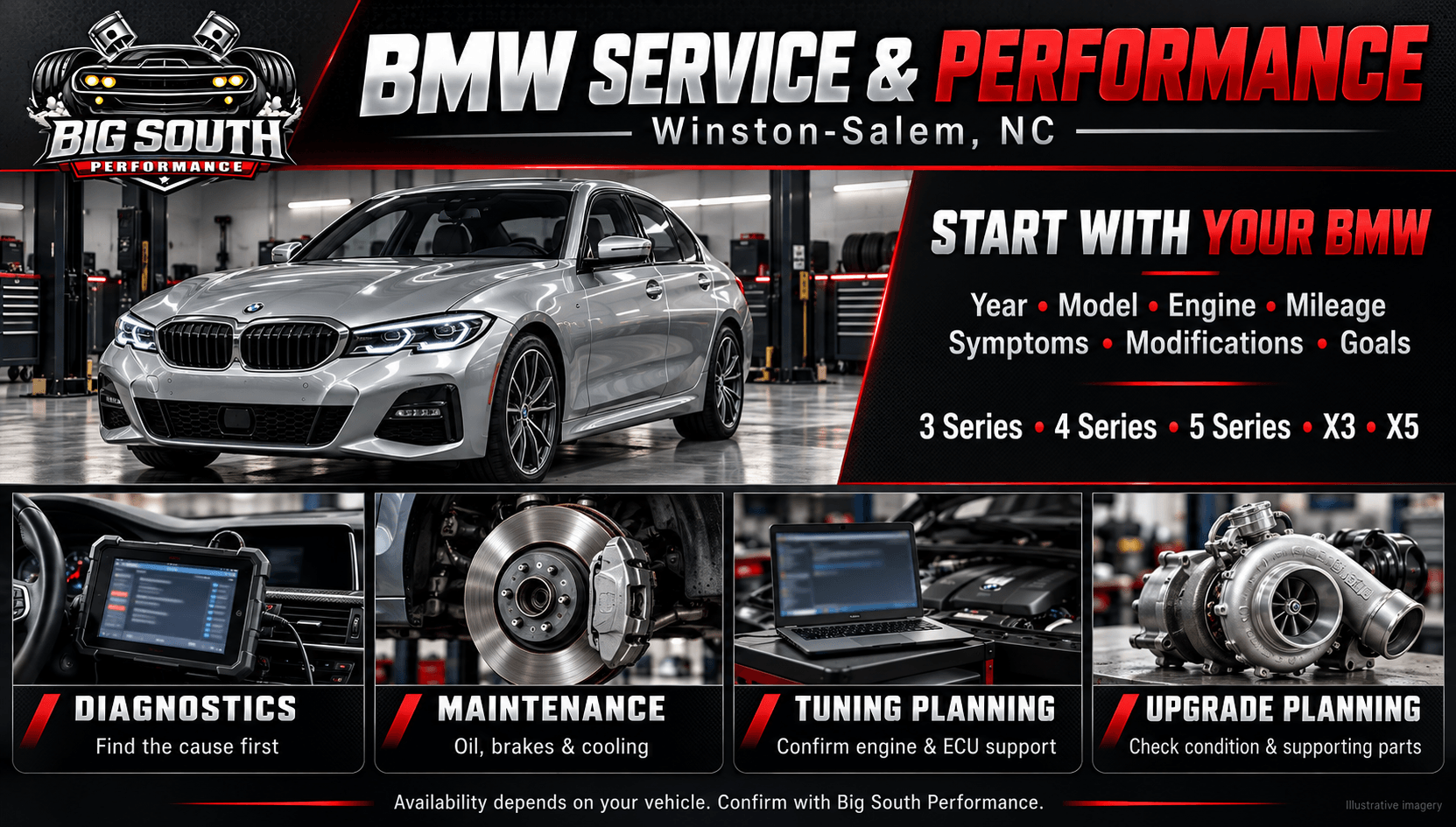
Find your model
Choose your model section below. Include the full designation when contacting the shop: a series name alone does not identify the engine, transmission, or drivetrain. Vehicles from different generations can share a familiar badge while using different parts and software.
For 3 Series repair in Winston-Salem, share the year and full model designation, along with the body style and drivetrain. An older 328i or 335i and a later 330i or M340i should not be treated as one service configuration. The exact vehicle matters more than a broad series label.
BMW’s official 3 Series materials provide a useful example: the 2019 330i uses a turbocharged four-cylinder engine, while the M340i configuration uses an inline-six. That distinction helps explain why parts, fluid requirements, and tuning support must be confirmed rather than copied between badges.
Describe warning lights, hesitation, leaks, or braking concerns separately from any upgrade goal. For a tuning enquiry, include existing hardware, calibration information, intended fuel, and daily driving priorities. Addressing an unresolved fault comes before selecting a performance change.
Discuss your 3 SeriesIdentify whether your 4 Series is a coupe, convertible, or Gran Coupe, then provide the year, full model designation, engine, and drivetrain. Body style and generation can affect what is relevant to the requested work. A photograph or sport appearance package is not a reliable specification.
For repair enquiries, explain whether the concern appears with cold starts, acceleration, braking, or normal cruising. Include prior repairs and installed parts. For a convertible mechanism, body-electronics issue, or other specialized task, confirm support when booking rather than assuming coverage from general repair availability.
For compatible performance planning, distinguish a 4 Series configuration from an M4 and provide the actual engine and ECU information. Similar branding does not establish interchangeable calibration support or a suitable parts combination.
Request a 4 Series service discussionA 5 Series owner may prioritize dependable commuting, comfortable travel, or reviewing a used vehicle’s service history. Share the year, full designation, mileage, and symptoms. The nameplate covers different generations and powertrains, so the service conversation must start with the car itself.
Report warning messages, fluid-level changes, vibration, or starting trouble accurately. If records are incomplete, identify what you know and what remains uncertain. Avoid authorizing a familiar online repair solely because another 5 Series owner described a similar symptom.
For performance enquiries, state the engine, existing modifications, current software, and goal. Hybrid, diesel, and other configurations require their own support review; general gasoline-engine tuning guidance should not be transferred automatically.
Ask about your 5 SeriesSend the year, full model designation, engine, drivetrain, and mileage. Explain whether the concern involves braking, steering, starting, cooling, or drivability. Mention recent tire changes, suspension work, and added equipment when relevant.
If you want to discuss X3 performance, provide the precise configuration and installed hardware. An X3, an M Performance version, and an X3 M should not be assumed to share every tuning option. Confirm support before selecting parts or software.
Discuss your X3Tell us how the X5 is used, including family travel, heavier loads, or towing when applicable. Provide the year, engine, drivetrain, and exact warning or symptom. Ride-height, transmission, hybrid, and other specialized concerns need a specific support discussion.
For an upgrade enquiry, identify the current configuration and your priorities. The proposed work should suit vehicle condition and intended use rather than follow a generic SUV performance package.
Request an X5 service discussionHave a 2 Series, 7 Series, Z4, another X model, or an M vehicle? Contact Big South Performance with the full configuration and requested work. A model omitted from this guide is an invitation to ask, not evidence of either universal coverage or automatic exclusion.
Clearly identify a plug-in hybrid, mild hybrid, or battery-electric vehicle. Confirm support for the particular system before booking. This page does not establish availability for high-voltage repairs, every factory software procedure, transmission rebuilding, or driver-assistance calibration. Combustion-engine turbo guidance does not apply to a battery-electric drivetrain.
Match software to the vehicle
Big South Performance offers performance and tuning services, with BMW support confirmed for the exact vehicle and requested work. A tuning conversation should identify the engine, ECU or DME, software status, transmission, installed parts, fuel requirements, and mechanical condition.
Explain your intended outcome in practical terms. Everyday response, a calibration to support compatible hardware, and a more involved performance project require different planning. Include your budget and tolerance for changes in drivability, sound, maintenance, and operating requirements.
Do not assume a “stage” label describes a universal package. Ask which parts and calibration it means for your vehicle. ECU access requirements and software compatibility also need confirmation; the presence of a turbocharger does not prove that a supported tuning path is available.
No fixed horsepower increase is promised on this page. Outcomes depend on the compatible hardware, calibration, fuel, and vehicle condition. Performance software should not be used to conceal a warning or replace a necessary repair.
Explore Big South Performance’s ECU tuning overview and contact us to discuss your BMW’s configuration.
A turbocharger repair, an upgrade to an existing turbo system, and adding forced induction are different projects. Identify the engine and explain the purpose of the request. A vehicle that has lost normal response needs investigation before a larger turbo is considered the solution.
“TwinPower Turbo” does not, by itself, mean two turbochargers. BMW’s official description of the 2019 330i includes a twin-scroll turbocharger within its TwinPower Turbo system. Verify the engine’s actual equipment rather than using the marketing name to select an upgrade.
Share symptoms, installed parts, previous repairs, and current calibration. Support for a replacement or upgraded turbo depends on the engine and fitment. Cooling, fueling, intake plumbing, calibration, and drivetrain requirements should be reviewed as part of the proposed scope.
A more involved project requires a conversation about condition, hardware compatibility, supporting systems, budget, and intended use. Confirm whether the complete build can be supported before ordering a kit or assuming that one component establishes the rest of the plan.
Brake, tire, suspension, intake, exhaust, and cooling changes should have a clear purpose. Discuss fitment, suitable road-use equipment, and everyday operation along with the performance goal. More parts do not automatically produce a more dependable or better-balanced daily driver.
| Your situation | Start with | Useful details |
|---|---|---|
| Warning message or rough running | Diagnostic discussion | Exact message, symptoms, conditions, and recent changes. |
| Service reminder or incomplete records | Maintenance review | Displayed items, mileage, invoices, and model-year documentation. |
| Previously modified BMW | Configuration and condition review | Parts list, existing tune, installation history, and goals. |
| ECU tune or turbo upgrade | Compatibility and scope confirmation | Engine, ECU, software, transmission, fuel, and budget. |
| Hybrid, EV, or specialized electronics | Task-specific support enquiry | Exact powertrain, system involved, and requested procedure. |
Repair cost depends on diagnosis, vehicle configuration, parts, and labor. A short symptom description can help arrange the initial discussion, but it may not establish the complete repair. Ask whether diagnostic work is separate and how additional findings will be presented for approval.
For performance work, request a scope identifying hardware, supporting changes, calibration, and included checks. Separate necessary repairs from optional upgrades so you can make a practical decision about priorities. A staged project should have a clear purpose for each step rather than a collection of parts purchased without confirmed compatibility.
Timing depends on scheduling, parts, and the agreed work. Mention transportation needs and deadlines early. Contact the shop for current availability and an estimate discussion rather than treating this page as a fixed price, same-day appointment, or completion guarantee.
Big South Performance offers general auto repair and performance services in Winston-Salem. Contact the shop with your BMW’s year, full model designation, engine, and requested work to confirm support and scheduling.
Yes. General repair and maintenance are part of the service offering alongside performance and tuning. Explain your service reminders, mileage, records, and any current concerns when requesting an appointment.
This guide includes 3 Series, 4 Series, 5 Series, X3, and X5 enquiries. Contact the shop about other BMW models. Availability must be confirmed for the exact configuration and requested task.
No universal tuning availability is promised. Support depends on the year, engine, ECU or DME, software, transmission, hardware, and vehicle condition. Confirm compatibility before buying parts or booking calibration work.
Send the year, full model designation, engine, transmission, drivetrain, installed parts, existing tune details, intended fuel, and goal. Include unresolved warnings, recent repairs, and your budget.
Not necessarily. The name alone does not identify the turbo configuration. BMW’s description of the 2019 330i includes a twin-scroll turbocharger. Verify your exact engine and equipment before discussing parts or upgrades.
An unresolved warning or drivability problem should be investigated before an upgrade is treated as the answer. A dashboard message needs context, and performance software does not replace diagnosis or necessary repair.
Use the documentation for your model year together with applicable service display information and maintenance records. Share displayed reminders, mileage, completed work, and current symptoms when requesting a review.
Yes, describe the vehicle and requested procedure when contacting the shop. This page does not establish support for every registration, coding, programming, or specialized electronic task. Confirm availability before booking.
No blanket availability is stated for specialized or high-voltage work. Identify the exact powertrain and affected system so support can be confirmed. Combustion-engine turbo guidance does not apply to a battery-electric drivetrain.
Yes. Provide the engine, installed hardware, calibration history, condition, and goal. Compatibility, supporting parts, and the complete project scope need confirmation before parts are purchased.
Cost depends on diagnosis or the confirmed upgrade scope, including parts, labor, calibration, and checks where applicable. Contact Big South Performance with the vehicle details and ask what is included in the proposed work.
Big South Performance is an independent business. BMW names identify the vehicles discussed on this page; no manufacturer affiliation or authorization is claimed.
The address is 2020 Cloverdale Avenue, Winston-Salem, NC 27103. Call (336) 512-2447 or use the contact page to discuss your BMW and confirm scheduling.
Tell us about your BMW
Ready to address a repair concern, review maintenance, or explore a compatible performance project? Send your year, full model designation, engine, mileage, symptoms, and installed modifications. Those details help Big South Performance discuss the requested work and confirm the next step.
Big South Performance
2020 Cloverdale Avenue
Winston-Salem, NC 27103
Confirm scheduling, vehicle compatibility, and requested service before making travel or parts-purchasing arrangements.
Use manufacturer documentation to verify maintenance information and model specifications. These resources are references, not evidence of dealer affiliation or support for a particular procedure at Big South Performance.
Big South Performance is an independent business. BMW names identify vehicles discussed here; no manufacturer affiliation or authorization is claimed.