Hyundai Repair in Winston-Salem, NC: Performance & Tuning
Need Hyundai repair in Winston-Salem, help keeping up with maintenance, or advice on a compatible performance upgrade? Big South Performance handles general auto repair alongside performance and tuning services. Tell us what you drive, what changed, and what you want the vehicle to do so we can discuss the appropriate next step.
Daily drivers and performance enquiries both start with the actual vehicle. An Elantra commuter, a Sonata N Line, a family SUV, and a modified Veloster need different conversations. The model guide below helps you prepare a service enquiry without assuming every Hyundai has the same engine, transmission, maintenance requirements, or tuning support.
2020 Cloverdale Avenue, Winston-Salem, NC 27103 • Contact us to confirm scheduling and support for the work you need.
General Hyundai repair and compatible performance services. The vehicle and garage are illustrative, not photographs of Big South’s premises or completed customer work.
Repair, Maintain, or Plan an Upgrade
Address a concern
Repair & Diagnostics
Warning lights, rough running, vibration, leaks, or a starting problem? Explain when the symptom appears and what changed. Identifying the cause comes before selecting a replacement part.
Bring your mileage and service history. The correct owner’s manual and your driving conditions help establish what is due, what has been completed, and what needs clarification.
Considering ECU tuning, supporting parts, or a turbo upgrade? Confirm mechanical readiness, vehicle-specific support, and the complete scope before committing to hardware or software.
Hyundai Repair & Diagnostics: Understand the Cause
A warning light describes a system concern, while a fault code helps guide investigation. Neither automatically identifies the failed component. A rough idle, hesitation, or unexpected vibration can have several causes. Useful diagnosis combines the symptom, service history, operating conditions, and relevant testing rather than relying on a guess from a code description.
For Hyundai repair in Winston-Salem, tell us whether the concern is constant or intermittent and whether it began after service, refueling, a battery change, or modifications. Include photographs of warning messages or a short description of the noise when possible. If another shop has already inspected the vehicle, share the findings and work performed.
Check Engine Lights & Rough Running
Describe whether the light is steady or flashing and whether the engine shakes, stalls, or loses response. Note cold versus warm operation and whether the symptom appears at idle or under acceleration. Stored codes are useful, but clearing them or replacing the component named in a code may not address the underlying problem.
Brakes, Steering & Suspension
Explain whether a vibration occurs while braking, at a particular road speed, when turning, or over bumps. Those patterns matter. Share recent brake, tire, wheel, or suspension work and any pothole or curb impact. Inspection should identify the relevant wear or fault instead of treating every noise or vibration as the same repair.
Leaks, Fluid Loss & Cooling Concerns
Record the fluid appearance, where it collects, and how often the level changes. A puddle may appear away from the actual source. Temperature warnings, recurring coolant loss, and repeated overheating need attention before a normal driving or performance plan continues. Adding fluid alone does not explain why it was lost.
Starting, Electrical & Shifting Issues
For starting concerns, distinguish no crank, slow crank, and normal cranking without starting. For electrical or shifting complaints, provide the exact warning and the conditions when it appears. Transmission type, installed accessories, battery history, and recent work can change the investigation. Confirm support for the particular task when booking.
What to Share Before Your Appointment
Hyundai repair enquiry guide
Concern
Useful information
Starting discussion
Check engine light or hesitation
Steady or flashing light, codes, temperature, and recent changes
Diagnosis before parts replacement or tuning
Noise or vibration
Road speed, braking, turning, load, and recent wheel or tire work
Inspection matched to the operating conditions
Leak or temperature warning
Fluid appearance, level changes, frequency, and warnings
Locate the cause and assess continued use
Starting or electrical problem
Cranking behavior, battery history, accessories, and messages
Confirm diagnostic scope and system support
Problem after modifications
Parts list, current tune, fuel, installation date, and symptom timing
Assess hardware, installation, and calibration together
Urgent symptoms need prompt attention. Severe rough running with a flashing check engine light, overheating, an oil-pressure warning, smoke, or a major loss of braking should not be treated as routine maintenance. Stop safely when appropriate and seek guidance on the next step rather than continuing normal driving.
Requirements matched to your Hyundai
Hyundai Maintenance & Service Planning
Use the owner’s manual for the exact model, year, engine, and transmission when reviewing maintenance. Mileage, elapsed time, previous work, and driving conditions all matter. The applicable schedule may differ from the one an online article gives for another Hyundai, even when the model names are similar.
Bring records for oil service, filters, relevant fluid work, brakes, tires, and repairs. With a used vehicle, separate documented work from assumptions about what the previous owner completed. A service reminder can help prompt attention, but resetting it does not prove the scheduled tasks were performed. Records make it easier to discuss what is genuinely due.
Oil, Filters & Fluid Specifications
Fluid type and service procedures should match the systems installed in your vehicle. Mention repeated top-ups, leaks, unusual noises, or a warning alongside your maintenance enquiry. A continuing fluid-loss concern deserves evaluation rather than being treated only as the next scheduled oil change.
Daily Driving & Modified Setups
Explain your typical use and any modifications. Factory maintenance guidance is the starting reference, while a performance configuration may have additional requirements to discuss. Avoid applying a universal “tuned car” interval without considering the hardware, calibration, and vehicle-specific information.
Visit Hyundai’s official owner resources for manuals and vehicle information. Identify a hybrid, plug-in hybrid, or electric powertrain before booking so support for the requested work can be confirmed. Gasoline engine oil service and turbo upgrade guidance should not be applied to a battery-electric Hyundai.
Hyundai Services at a Glance
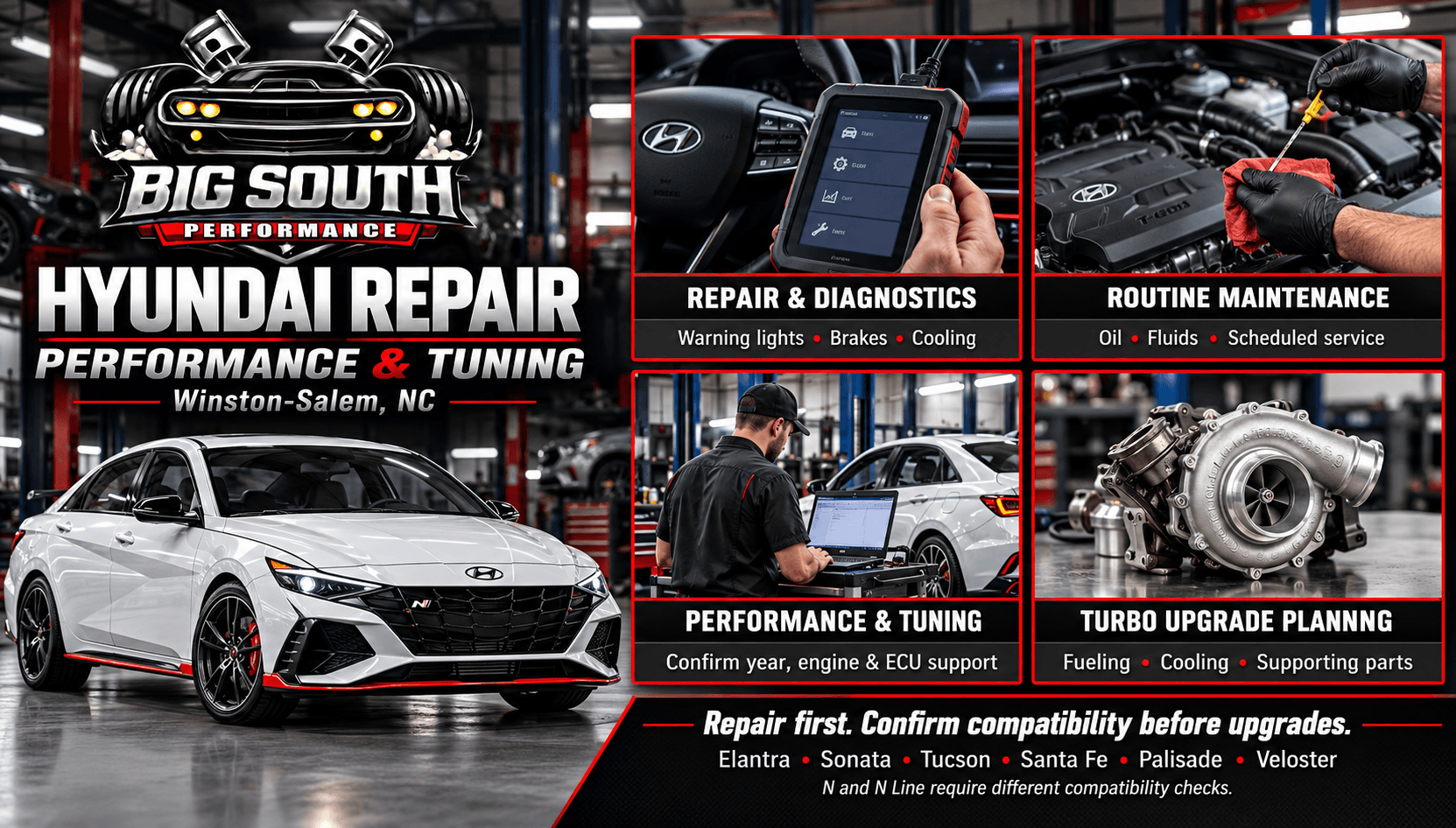
Start with dependable operation, then consider compatible upgrades. General repair, routine care, and performance projects have different scopes, even when they involve the same vehicle.
Illustrative Hyundai service overview. Tuning depends on the actual configuration; N and N Line require separate compatibility checks. Vehicles, technicians, and garage scenes are AI-generated illustrations.
Jump directly to the model you drive. These sections help prepare a useful service enquiry; they do not claim that every example develops the symptoms mentioned. If your model is not listed, contact us with its year, powertrain, and requested work. Support for one trim or engine does not automatically extend to the rest of the range.
Hyundai Elantra Repair & Performance
For Hyundai Elantra repair in Winston-Salem, provide the year, trim, powertrain, mileage, and symptoms. An everyday Elantra, an Elantra Hybrid, an N Line, and an Elantra N should not be treated as interchangeable configurations. Correct identification helps with maintenance information, parts, and the scope of an enquiry.
For performance work, specify the actual engine and transmission rather than saying only “sport model.” Include installed hardware and current software. Restore reliable running first if the car has warning lights or hesitation. An N badge or an N Line trim name alone does not establish support for a particular calibration or upgrade.
A Sonata enquiry should include the model year and powertrain, including any hybrid configuration. Explain changes in starting, idle quality, acceleration, shifting, braking, or fluid levels. If the concern appears only after warming up or at a particular speed, include that detail alongside maintenance records and recent work.
For Sonata N Line performance enquiries, identify the specific setup and goal before selecting parts. A Sonata parts list or calibration from another year or engine may not be suitable. Ask about available support, required supporting work, and how the proposed change fits your vehicle’s condition and everyday use.
For Tucson service, identify the year, powertrain, drivetrain, mileage, and the work you need. Gasoline, hybrid, and plug-in hybrid configurations should be named clearly when applicable. Brake noise, vibration, cooling concerns, and warning messages need an assessment matched to the actual vehicle and operating conditions.
A Tucson N Line enquiry also needs powertrain information; styling does not determine tuning support. If your goal is a dependable family vehicle, discuss due maintenance and existing concerns first. If your goal is an upgrade, confirm compatibility separately rather than using a performance package advertised for another Hyundai.
Santa Fe owners should share the year, engine or electrified powertrain, drivetrain, and maintenance history. Describe a symptom by when it happens: at startup, while braking, under load, over bumps, or after a longer drive. Include towing use, installed accessories, or recent repairs when they are relevant to the concern.
Service planning should follow the applicable owner’s manual and the condition of the vehicle. For modifications, define the intended result and confirm specific support. A familiar model name can cover substantially different hardware, so parts fitment and performance options need a review of the exact configuration.
For Palisade repair and maintenance, bring the model year, powertrain, mileage, and service records. Explain whether the vehicle regularly carries passengers, is used for towing, or has had wheel and tire changes. Those details provide context for a discussion about wear, vibration, braking, and the applicable maintenance schedule.
Start a modification enquiry with the work you want and the configuration you own. Confirm availability before purchasing parts or assuming that tuning offered for an Elantra N also applies to a Palisade. For many owners, preserving consistent operation and catching up on due care will be the main service priority.
Identify the Veloster’s year, engine, trim, transmission, and modification history. A standard Veloster, a Turbo version, and a Veloster N should not be described as the same setup. For rough running, shifting concerns, cooling problems, or unusual noise, note the conditions and any changes made before the symptom began.
For a modified Veloster, provide the complete hardware list and known calibration details. A package label does not identify every part or software change. Performance support needs to match the actual engine, ECU, and transmission, with maintenance and mechanical concerns reviewed before a further upgrade is proposed.
When asking about Kona service, name the model year and powertrain, including whether it is a gasoline vehicle or Kona Electric. Describe the warning, maintenance need, or change in behavior and confirm support for the relevant system. An electric model requires different service guidance from a combustion-engine vehicle.
For a Kona N or N Line enquiry, provide the exact version rather than assuming the badges indicate equivalent hardware. Performance availability is specific to the configuration and intended work. For another Kona trim, a useful enquiry may focus on routine care, braking, starting, or resolving a current drivability concern.
The Hyundai Genesis Coupe has its own clearly labeled section on our Genesis service page. Use that section for Coupe identification and tuning enquiries so the vehicle is distinguished from Genesis-brand sedans. The same principle applies to an older Hyundai Genesis sedan: include the year and engine when contacting us.
Have an Accent, older Santa Fe Sport, IONIQ model, or another Hyundai not listed here? Contact us with the exact vehicle and task to confirm support. Inclusion in the Hyundai range does not establish availability for every specialist system or performance project.
Hyundai N and N Line are different designations. N identifies dedicated performance models, while N Line identifies sport-oriented versions within model ranges. The equipment associated with either designation depends on the model and year. Do not assume an N Line has the same engine, transmission, brakes, calibration, or upgrade support as an N model.
For an Elantra N, Veloster N, or Kona N enquiry, provide the year and configuration along with your goals. For an Elantra N Line, Sonata N Line, or another N Line, do the same. Neither designation is enough to choose an aftermarket component or confirm ECU support without checking the actual vehicle.
Performance interests also extend beyond the engine. Braking, tires, ride quality, cooling, and how the vehicle will be used belong in the discussion. Explain whether you want dependable daily use, restored factory response, or a compatible modification, and confirm the proposed scope before buying a package.
Compatibility before calibration
Hyundai Performance Tuning & ECU Support
Big South Performance offers performance and tuning services alongside general repair. For Hyundai performance tuning in Winston-Salem, the first step is to establish support for the exact year, engine, ECU, transmission, and hardware. Sharing an engine family or a trim name with another car does not prove the same calibration is appropriate.
Describe the result you want and what is already installed. A vehicle with reduced performance needs diagnosis; a healthy vehicle being modified needs a compatibility and project discussion. Software should not be treated as a substitute for fixing rough running, overheating, warning lights, or an installation fault.
Information to Provide
Year, model, trim, engine, transmission, and drivetrain.
VIN and ECU identification when requested.
Installed parts and any previous calibration changes.
Fuel normally used and intended vehicle use.
Symptoms, warning messages, and relevant maintenance records.
Questions Before Proceeding
Is tuning support available for this exact configuration?
Which supporting components does the proposal require?
What fuel requirements and operating limits apply?
How will installation and operating behavior be checked?
What follow-up and maintenance should be expected?
An off-the-shelf calibration, a custom file, and an add-on control device are different approaches. Confirm the service available for your vehicle instead of assuming a particular platform or testing arrangement. Discuss manufacturer coverage and applicable emissions requirements before proceeding with the proposed configuration.
There is no universal horsepower gain or best tune across the Hyundai lineup. For the broader service overview, visit our ECU tuning page, then contact us with your vehicle information to discuss specific options.
Plan more than the headline component
Hyundai Turbo Upgrades & Supporting Parts
A factory-turbo upgrade and adding a turbocharger to a vehicle without one are different projects. Both need a review of mechanical condition, fitment, supporting systems, calibration availability, intended use, and total scope. A kit advertised for a similar car may not establish compatibility with yours.
Hardware & Vehicle Readiness
Discuss fuel delivery, charge-air cooling, heat management, relevant oil or coolant connections, and drivetrain suitability alongside the turbo itself. Resolve known faults and recurring fluid or temperature concerns first. A turbo component price does not include every part or labor requirement in a complete project.
Calibration & Verification
The planned hardware needs an appropriate calibration approach and agreed fuel requirements. Ask how the installation and resulting behavior will be checked and what follow-up is included. Specific support, test arrangements, and operating limitations should be confirmed in the proposal rather than assumed.
Adding forced induction to a vehicle that did not have it can involve substantially more work than replacing an existing turbocharger and may not be practical for your budget or goals. Start with an assessment before purchasing hardware. The appropriate next modification depends on the actual setup, not simply the largest available turbo or advertised output.
Know what is being proposed
Hyundai Repair & Performance Estimates
A useful estimate depends on the confirmed problem or agreed project scope. Repair costs vary with parts requirements, access, labor, and diagnostic needs. Performance work can also involve supporting hardware, installation, calibration, and verification. A single generic price would not describe all those configurations accurately.
When requesting an estimate, share your priorities and ask whether assessment is needed first. Confirm what is included and what may depend on inspection findings. For an upgrade, compare complete proposals rather than the price of one component, and separate necessary repair from optional modifications.
Start with a specific message: “I have a [year] Hyundai [model/trim] with [powertrain], [transmission], and [mileage]. The issue or goal is [details]. It is [stock/modified], and recent work includes [details].” Include when a symptom appears or the intended use of an upgrade.
Answers before you book
Hyundai Repair & Tuning FAQs
Does Big South Performance do general Hyundai repair?
Yes. Big South Performance handles general auto repair alongside performance and tuning services. Share the year, model, powertrain, mileage, and concern to confirm support for the required work and scheduling.
Which Hyundai models can I enquire about?
This page covers Elantra, Sonata, Tucson, Santa Fe, Palisade, Veloster, and Kona enquiries. Contact us about another model with its exact details and requested task. Service support is confirmed for the actual configuration.
Are Hyundai N and N Line the same?
No. They are different designations with equipment that varies by model and year. Do not assume they share the same engine, transmission, parts, or calibration support. Provide the exact vehicle before discussing service or upgrades.
Can I ask about Elantra N or Veloster N tuning?
Yes. Provide the year, engine, transmission, installed hardware, current calibration, fuel used, and goal. Support and mechanical readiness need to be confirmed for the proposed work.
Can every Hyundai be ECU tuned?
No. Availability depends on the year, engine, ECU, transmission, hardware, and vehicle condition. Contact us before purchasing parts or software. A sport trim name alone does not establish compatibility.
Can tuning fix a check engine light?
A check engine light needs diagnosis. Identify and address the cause rather than treating a performance tune as a substitute for repair. Mechanical, electrical, installation, and calibration problems can produce overlapping symptoms.
Can I add or upgrade a turbocharger on my Hyundai?
A vehicle-specific review is needed. A factory-turbo upgrade and a conversion on a vehicle without a turbocharger have different requirements. Engine condition, fitment, supporting systems, calibration, use, and total cost determine feasibility.
How often does my Hyundai need maintenance?
Use the owner’s manual for the exact model, year, and powertrain, including the schedule applicable to your driving conditions. Bring service records and mileage so completed work and due items can be reviewed.
Can I enquire about a Hyundai that is already modified?
Yes. Share the complete parts list, current tune, installation history, vehicle details, and concern. Support depends on the setup and requested work. Mention modifications made before a symptom began.
What about hybrid, plug-in hybrid, or electric Hyundais?
Identify the powertrain before booking and confirm support for the specific task. Gasoline-engine oil service, tuning, and turbo guidance should not be applied to a battery-electric vehicle. Specialist work must be discussed for the actual system.
Where should Hyundai Genesis Coupe owners start?
Use the Hyundai Genesis Coupe section on our Genesis service page, then contact us with the year, engine, transmission, and requested work. The Coupe is a Hyundai model and is distinct from Genesis-brand G70, G80, and G90 sedans.
How much does Hyundai repair or tuning cost?
The estimate depends on the diagnosis or confirmed upgrade scope. Share vehicle details, symptoms, installed parts, and goals. Ask what diagnostic work, parts, labor, calibration, and verification are included where applicable.
Where is Big South Performance located?
Big South Performance is at 2020 Cloverdale Avenue, Winston-Salem, NC 27103. Call (336) 512-2447 to discuss your Hyundai and confirm scheduling before visiting.
Repair, maintain, or plan your next step
Talk to Big South About Your Hyundai
For Hyundai repair in Winston-Salem, maintenance planning, or compatible performance and tuning services, begin with your vehicle and the result you need. Contact us to discuss the next step and confirm support before scheduling or buying upgrade parts.
Manufacturer documents help identify specifications and maintenance requirements. Check recalls by VIN and follow the manufacturer’s instructions for an applicable remedy. An independent repair enquiry does not replace the manufacturer’s recall process.
Big South Performance is an independent service provider. Hyundai model names identify vehicles and do not imply manufacturer affiliation. Promotional vehicle, technician, and garage imagery is AI-generated.