
Big South Performance • Winston-Salem, NC
Engine Repair in Winston-Salem, NC
Rough running, recurring leaks, overheating, or a new engine noise deserves a repair decision based on findings. Contact Big South Performance for engine repair in Winston-Salem and explain what changed, when it happens, and how the vehicle is operating now.
Big South Performance provides engine diagnostics, engine repair, cooling-system repairs, and component replacement. The right starting point is understanding the fault and its extent. An ignition problem, an external leak, and internal engine damage can require very different work; the symptom alone does not establish the repair.
Confirm vehicle support, appointment availability, and the service location before visiting. If the engine is overheating, an oil-pressure warning appears, or operation is unsafe, stop safely and arrange assistance.
Quick Answer
When does your vehicle need engine repair?
Engine repair is appropriate when testing confirms a fault that requires mechanical or component work. Request evaluation for rough running, recurring fluid loss, overheating, abnormal noise, or reduced power. These symptoms do not automatically mean the entire engine needs replacement. A useful recommendation identifies the cause, explains the repair scope, and considers whether damage extends beyond the first failed component.
Safety Comes First
When Should You Stop Driving?
Stop safely and seek assistance if an oil-pressure warning appears while the engine is running, the engine overheats, severe knocking develops, or smoke accompanies unsafe operation. Follow the owner’s manual for the exact warning. Do not keep restarting an engine to see whether a serious symptom disappears.
An oil-pressure warning is different from a routine oil-change reminder. A normal dipstick reading does not establish that oil pressure is adequate. An overheating warning also needs prompt action; do not open a hot cooling-system cap or reach around moving components to investigate.
If you see suspected fire or heavy smoke, leave the vehicle safely, move away, and contact emergency assistance when appropriate. Discuss towing and arrival arrangements with the shop when further driving could worsen the fault. This page cannot determine vehicle safety remotely.
01 / Recognize the Concern
Which Engine Symptoms Need Inspection?
Persistent rough running, fluid loss, overheating, unusual noise, and loss of power should be evaluated before choosing parts. Record whether the concern occurs during a cold start, at warm idle, under acceleration, or after a recent repair. A pattern can help distinguish a repeatable fault from an intermittent condition.
| What you notice | Possible evaluation areas | What helps the service request |
|---|---|---|
| Rough idle or misfire | Ignition, air or fuel delivery, wiring, compression, and other causes of uneven combustion. | Cold or warm engine, warning-light behavior, and any existing code report. |
| Oil leak or falling oil level | External leaks, oil consumption, crankcase ventilation, or another source of fluid loss. | Where residue appears, how frequently the level changes, and prior repairs. |
| Overheating or coolant loss | Cooling-system integrity, circulation, temperature control, and possible related engine damage. | Warning messages, when temperature rises, and any loss of coolant. |
| Ticking, knocking, or rattling | Accessories, timing-related components, lubrication, or internal mechanical condition. | Whether the noise changes with temperature, engine speed, or load. |
| Hesitation or reduced power | Airflow, ignition, fuel supply, engine controls, or mechanical limitations. | When power drops and whether another warning or symptom appears. |
| Smoke or unusual exhaust behavior | Fluid entry, combustion, temperature, and other vehicle-specific operating conditions. | When it occurs, whether it persists, and accompanying fluid loss or warnings. |
These are diagnostic possibilities, not confirmed causes. A symptom or fluid color alone does not identify the failed component.
Does rough running mean the engine is worn out?
No. A rough-running engine can have an ignition, air, fuel, electrical, or mechanical concern. Testing determines which direction is supported. A misfire code does not automatically justify a replacement engine, and a new spark plug or coil is not automatically the complete repair.
Does every new noise come from inside the engine?
No. Belt-drive accessories and related components can produce noises near the engine. The sound must be located and interpreted in context. Severe knocking still warrants stopping safely rather than repeated road tests. Describe the noise and operating conditions without selecting a repair before inspection.
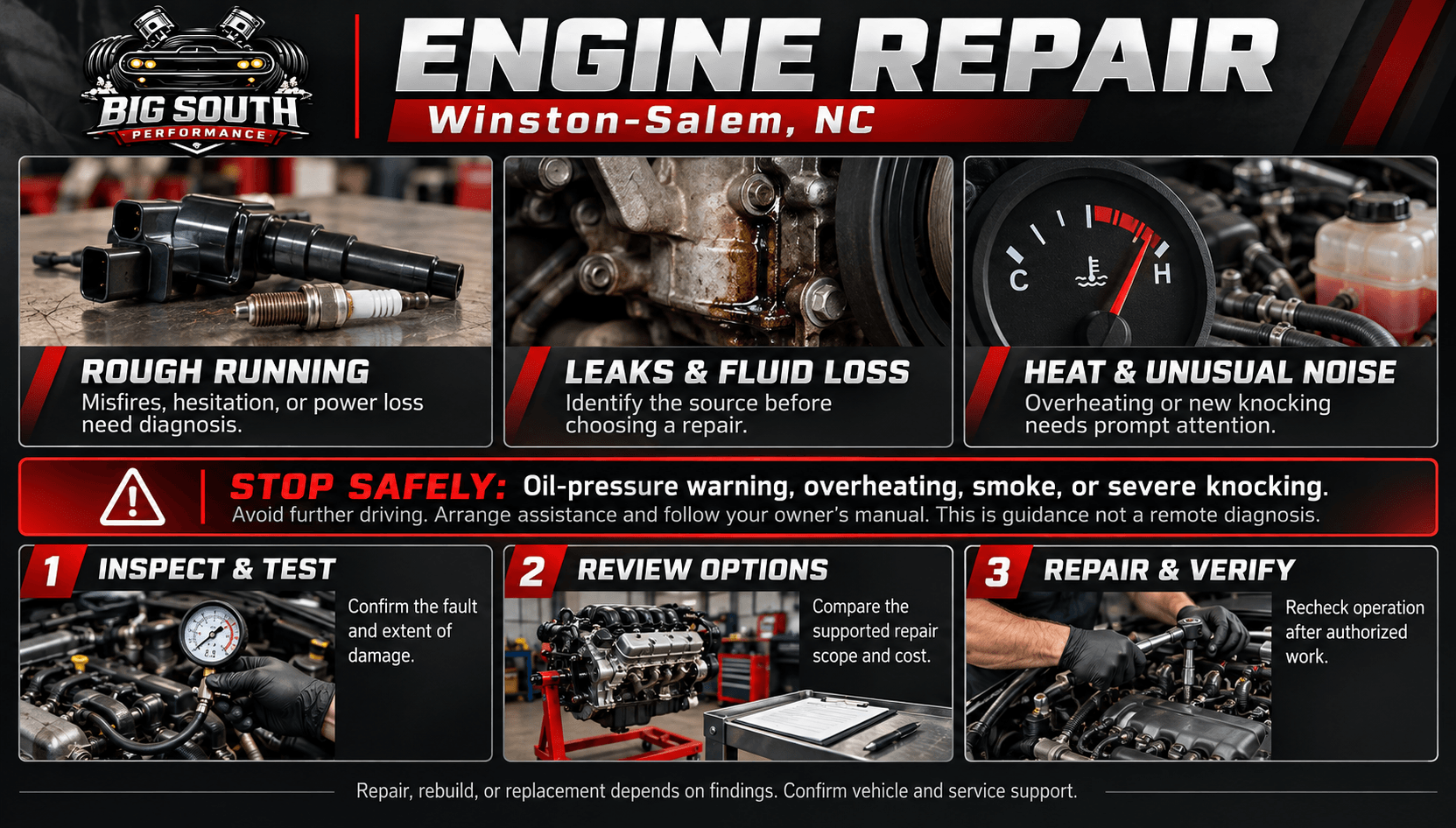
Visual Repair Guide
Recognize the Concern. Review the Options.
Use this overview to describe warning signs and understand the path from inspection to an authorized repair. Urgent warnings need the response specified in your owner’s manual.
02 / Repair the Confirmed Fault
Engine Repair Options at Big South Performance
The appropriate work depends on the confirmed fault, vehicle configuration, and extent of damage. Big South Performance lists engine repair, cooling-system repairs, and component replacement among its automotive services. Discuss the actual task before booking, especially when specialized testing or major internal work may be required.
Rough Running and Ignition Concerns
A supported repair may address an ignition component, wiring issue, air leak, or another confirmed cause of poor operation. Ask why the proposed part needs replacement and whether related components were evaluated. A misfire can have more than one contributing condition.
Leaks and Fluid-Loss Concerns
Locate the source before deciding whether a gasket, seal, housing, hose, or another component needs work. Fluid can travel away from the original leak, so residue at one location is not conclusive. Ask how the repair addresses the source and how its result will be checked.
Cooling-System and Overheating Concerns
Cooling-system repairs should address the reason for temperature or coolant loss. Depending on findings, the investigation may involve leaks, circulation, temperature control, or related engine condition. Replacing one suspected part without confirming the cause can leave the overheating concern unresolved.
Mechanical Condition and Component Work
Abnormal noise, compression concerns, or other evidence may require a closer mechanical assessment. Confirm support for the exact engine and procedure before ordering parts. Timing-system work, cylinder-head repairs, machining, rebuilding, and replacement need a defined scope and service confirmation.
The objective is to correct the cause, not simply replace the component named in a code description. NGK’s ignition guidance emphasizes considering the coil, boot, and spark plug together rather than viewing the coil in isolation. That principle supports a complete inspection of the affected system before a repair decision.
What if the check engine light is the only symptom?
Start with check engine light diagnostics when the warning is the primary concern and the repair has not yet been identified. This engine-repair page explains the decisions after a fault is supported by findings. Both services can be part of one job, but diagnosis and repair answer different questions.
03 / Understand the Recommendation
Do You Need a Repair, Rebuild, or Replacement Engine?
The decision depends on damage, repairability, vehicle condition, parts availability, and the complete cost. A localized fault may be repairable without removing the entire engine. Extensive damage may justify discussing a larger solution. Neither the warning light nor the vehicle’s mileage alone establishes which option is appropriate.
Engine repair corrects a confirmed fault in the existing engine or its related components. A rebuild generally involves disassembly, inspection, measurement, and reassembly with the necessary components and preparation. Replacement installs another suitable engine assembly. The exact included parts and work must be documented because these terms do not define one universal package.
| Option to discuss | What should support it? | Questions before authorization |
|---|---|---|
| Targeted component repair | A confirmed fault with a repairable component or system and an assessment of related condition. | Why is this repair sufficient, and what checks address the original concern? |
| Larger mechanical repair | Findings that justify additional disassembly or work beyond an external component. | What is known now, what remains uncertain, and when will further approval be needed? |
| Rebuild | An engine that can be restored within the applicable specifications and a defined assembly or machining scope. | Is this service supported for the engine, and which parts, preparation, and installation tasks are included? |
| Replacement engine | Compatibility review and a comparison with repairing the damaged assembly. | Is the proposed assembly used, remanufactured, or new, and what additional work and warranty terms apply? |
What should a major-engine estimate include?
Ask which assembly is being supplied, what is transferred from the existing engine, and whether installation includes required fluids, seals, accessories, software work, and verification. Clarify any core-return requirements and the source of warranty coverage. A low assembly price is not the complete installed cost when other work remains necessary.
Should the original cause be addressed before replacement?
Yes. The repair plan should consider the condition that caused the failure, such as a confirmed cooling, lubrication, or related system fault. Installing another assembly while leaving the original problem unresolved can put the replacement at risk. Ask how the recommendation accounts for the cause and whether supporting components require evaluation.
Rebuilds, machining, and replacement are decision categories, not a guarantee of availability for every engine. Confirm the exact service, parts source, and compatibility with the team before proceeding.
04 / Evidence Before Authorization
What Findings Should Support an Engine Repair?
A useful recommendation connects the complaint, test results, and proposed work. Depending on the concern, evaluation may involve a visual inspection, scan information, fluid-system testing, electrical checks, compression or leak-down testing, or another vehicle-specific procedure. These are possible methods, not a checklist required for every appointment.
Ask What the Test Established
A result is most helpful when interpreted against the correct engine specifications and test conditions. Ask whether it confirms the proposed cause, suggests further investigation, or leaves an intermittent concern unresolved. One measurement should not be described as proving every aspect of engine health.
Ask What Remains Unknown
Some conditions become clear only after authorized disassembly. Ask what the initial estimate assumes, which discoveries could change the scope, and how the team will request additional approval. Understanding the limits of the first inspection helps prevent an incomplete estimate from being mistaken for a final commitment.
For example, low compression can direct investigation toward a mechanical concern, but it does not by itself establish the entire repair scope. A leak found during inspection may need evaluation of surrounding components. The diagnostic method should match the problem rather than adding tests or parts without a reason.
05 / Plan the Work
How Much Does Engine Repair Cost?
Engine repair pricing depends on the confirmed problem, access, parts, labor, and related work. An ignition-component repair and a major internal-engine job are different scopes. Request an estimate that identifies the actual work rather than comparing one general “engine repair” price with another.
- Diagnosis: The initial testing charge, included time, and authorization for further investigation.
- Access and disassembly: Labor needed to reach the affected components or inspect damage.
- Parts and materials: The specified components, required fluids, seals, fasteners, and other necessary items.
- Related repairs: Supporting work justified by findings, including the condition that caused damage.
- Verification: Checks required to evaluate the repaired system and original symptom.
Ask whether labor, materials, applicable taxes, and any outside services are included. Confirm the stated warranty terms and whether they cover parts, labor, or both. Big South Performance’s team can discuss the initial request; the final scope depends on the vehicle and findings.
How long will the repair take?
Timing depends on diagnostic progress, parts availability, service access, and whether additional damage is found. A component replacement may have a different schedule from an engine removal or major mechanical job. Ask when the team expects to provide findings, when parts can be confirmed, and how the delivery estimate changes if further work is authorized.
Is repairing an older vehicle worthwhile?
Compare the proposed engine work with the vehicle’s overall condition, other needed repairs, intended ownership period, and the cost of an alternative vehicle. Age or mileage alone should not make the decision. A written scope helps you decide whether the repair fits your needs without assuming every expensive engine concern requires replacement of the entire car.
06 / Keep Repair Goals Clear
Engine Repairs for Standard and Modified Vehicles
Big South Performance provides automotive repair and performance services. Share the existing configuration before evaluation: engine changes, intake or exhaust parts, forced induction, wiring alterations, and previous tuning can affect the starting point. The goal of this service page is correcting faults and restoring operation; a power upgrade requires its own planning.
If you want a different powertrain configuration, discuss engine swaps and vehicle integration . If the objective is a purpose-built performance combination, review custom performance engine builds . These projects involve different compatibility, budget, and supporting-system questions from repairing an existing fault.
Resolve the vehicle’s mechanical condition before deciding whether calibration is appropriate. A tune is not a general remedy for low oil pressure, overheating, compression loss, or an unresolved misfire. Read why warning-light concerns should be investigated before tuning when planning both repairs and upgrades.
07 / Prepare for Service
How to Request Engine Repair in Winston-Salem
Send a clear description through the Big South Performance contact page or call the team. The request should explain the current condition so service support, scheduling, and arrival arrangements can be reviewed before the appointment.
- Identify the vehicle. Provide the year, make, model, engine, mileage, and the VIN when requested through the shop’s contact process.
- Describe the concern. Explain warning messages, noise, rough running, fluid loss, overheating, and whether the vehicle currently starts or drives.
- Share its history. Include recent repairs, overheating events, service records, modifications, scan results, and previous attempts to fix the problem.
- Confirm the appointment and scope. Ask about initial diagnostic charges, exact vehicle support, the service location, and whether towing is appropriate.
- Review the findings before authorizing repairs. Discuss the proposed work, estimate, remaining uncertainties, and verification plan before additional service proceeds.
Do not repeatedly start a damaged engine or reproduce an unsafe symptom for a recording. Notes, prior invoices, and photos taken while safely parked can help describe the concern. Keep the original code report when available rather than sending only a guessed component name.
Local Repair Support and Vehicle Compatibility
Big South Performance serves Winston-Salem and the Piedmont Triad. Review the vehicle makes information and confirm the actual task for your engine configuration. Hybrid powertrains, diesel engines, unusual conversions, and major internal repairs may require additional review. Learn more about the shop’s repair and performance approach before sending your request.
08 / Common Questions
Engine Repair FAQs
1. Does a check engine light mean I need a replacement engine?
No. A check engine light indicates a monitored fault, not an automatic engine-replacement decision. The cause may involve ignition, fuel or air delivery, wiring, emissions-related components, or mechanical condition. Start with diagnosis and ask what the findings support. Replacement should be considered only after the damage, repairability, compatibility, and complete cost have been evaluated for the actual vehicle.
2. Can I drive with an oil leak?
A leak needs assessment of its source, rate, and effect on the vehicle. Do not assume that a small spot proves the concern is harmless. An oil-pressure warning, smoke, severe noise, or unsafe operation calls for stopping safely and arranging assistance. Follow the owner’s manual and contact the team about arrival arrangements. Adding oil does not repair the source of a leak.
3. What should I do if the engine overheats?
Stop safely, switch off the engine when instructed by the owner’s manual, and arrange help rather than continuing to test the temperature. Do not open a hot cooling-system cap. Overheating can involve leaks, circulation, temperature control, or other faults, and the engine may need evaluation for related damage. A temporary return to normal temperature does not establish that the cause has been corrected.
4. Does a misfire always need new spark plugs or coils?
No. Ignition components are possible causes, but a misfire can also involve air or fuel delivery, wiring, compression, or another condition. A code provides a diagnostic direction rather than a complete parts list. Ask what testing supports the proposed replacement and whether related components were inspected. Correcting the cause matters more than replacing a familiar part before the fault is established.
5. Can an engine leak be repaired without removing the engine?
Sometimes. Access depends on the leak location, component design, and vehicle configuration. Some external repairs can be completed with the engine installed, while other work may need significant disassembly or removal. Ask which source was confirmed, what access is required, and what related parts or materials are included. The leak’s appearance alone does not establish the labor or final repair scope.
6. How do I choose between engine repair and replacement?
Compare the confirmed damage, repairability, vehicle condition, compatible replacement options, and complete installed cost. A targeted repair may be sufficient for a localized fault; extensive damage may justify a broader solution. Request the findings behind the recommendation and discuss warranty terms, supporting work, and remaining uncertainties. Confirm the shop’s support for the exact procedure before authorizing major engine work or ordering an assembly.
7. Does Big South Performance offer engine rebuilds for every vehicle?
Do not assume universal rebuild availability. Big South Performance publishes engine repair and custom performance engine services, but the exact engine, required machining, assembly work, parts supply, and installation scope need confirmation. Send your vehicle details and findings to the team. Discuss which work is supported and how it would be estimated before treating a rebuild as the agreed solution.
8. How much does engine repair in Winston-Salem cost?
The price depends on the vehicle, confirmed fault, access, parts, labor, and related work. An external component repair and a major mechanical job are different estimates. Ask whether diagnosis, materials, fluids, applicable taxes, outside services, and verification are included. Contact Big South Performance with the symptoms and vehicle history so the team can discuss the initial evaluation and explain how repair pricing is determined.
9. Can performance tuning fix an engine problem?
Performance tuning is not a substitute for repairing an unresolved mechanical fault. Overheating, lubrication concerns, compression loss, and active misfires need evaluation before additional performance demands are considered. Tell Big South Performance about previous software changes and installed parts. The team can review the vehicle’s condition and goals, but the appropriate repair should follow the findings rather than a request to hide a symptom.
10. What should I bring or send for an engine repair appointment?
Provide the vehicle’s year, make, model, engine, mileage, symptoms, warning messages, recent repairs, and modifications. Include available scan reports, service records, and safely taken photos. Confirm the initial appointment scope, service location, and arrival arrangements with Big South Performance. Submitting a contact request does not confirm an appointment, and a vehicle with serious engine warnings may need towing instead of another road trip.
Start With the Condition. Choose the Supported Repair.
Request Engine Repair at Big South Performance
Tell the team what changed and how the vehicle is operating now. A clear history helps establish the next evaluation step and the information needed for an appropriate repair recommendation.
Confirm the appointment, exact service support, and location before visiting. Discuss towing when engine condition makes further driving unsafe.